
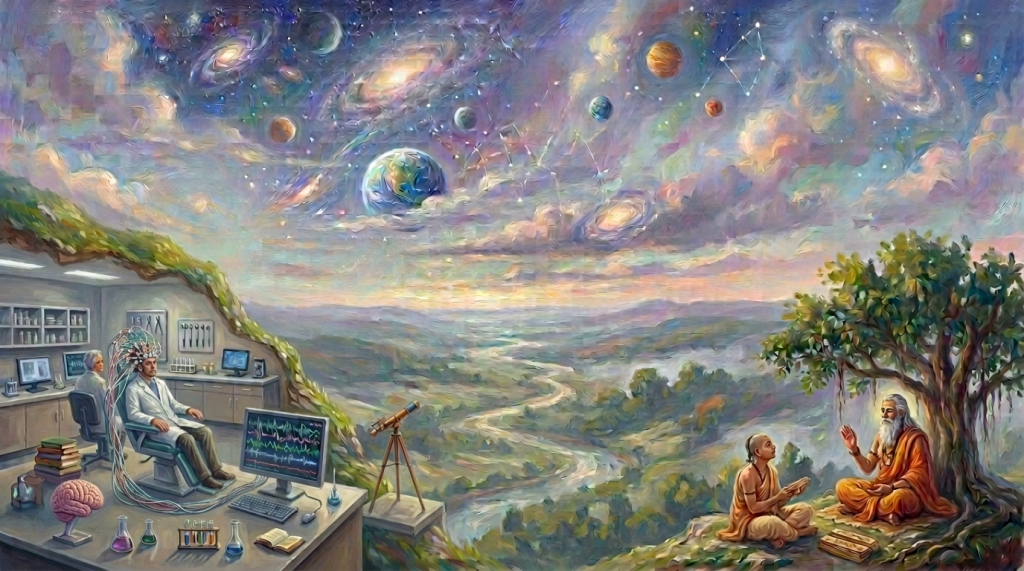
Abstract: The fundamental questions concerning Consciousness have given numerous deep thinkers sleepless nights. Science, too, has tried to explain the emergence of Consciousness. However, an understanding of Consciousness continues to elude science as well. And for good reasons, as discussed in this essay. Advaita Vedanta is an ancient yet timeless teaching tradition that involves an inquiry into the questions related to Consciousness guided by the ancient texts of Vedanta. This essay presents insights into the Nature of Consciousness gathered from Advaita Vedanta.
Introduction
मय्येव सकलं जातं मयि सर्वं प्रतिष्ठितम्
मयि सर्वं लयं याति तद्ब्रह्माद्वयमस्म्यहम् ||
mayyeva sakalaṃ jātaṃ mayi sarvaṃ pratiṣṭhitam
mayi sarvaṃ layaṃ yāti tadbrahmādvayamasyaham
In me, this universe appears. In me, this universe is sustained. In me alone, this universe resolves. That non-dual Brahman (Limitless Consciousness), I am!
Kaivalya Upaniṣad Mantra 29
Philosophers, ancient and modern, have grappled with the idea of Consciousness. What is Consciousness fundamentally? How does it come into being? What is its Nature? Since time immemorial, these questions, amongst others, have given numerous deep thinkers sleepless nights. Over the past century, Science has tried to probe deeper into the physical world around us to understand the building blocks of matter. However, an understanding of Consciousness continues to elude Science as well. And for good reasons, as I hope to present in the sections that follow.
As conscious beings, Consciousness is not only an essential aspect, but arguably the most fundamental aspect of our existence. Hence, the two questions “Who am I?” and “What is Consciousness?” are essentially inseparable. Over three decades ago, my search for answers to these fundamental questions brought me to the hallowed ancient tradition of Advaita Vedanta (Non-Dualistic Vedanta).
Advaita Vedanta is an ancient yet timeless teaching tradition that involves an inquiry into the most fundamental question of “Who am I,” guided by the ancient teachings of Vedanta. The teachings of Advaita Vedanta are a part of the ancient Vedas and are found in the final portion of the Vedas, known as Vedanta. These teachings have traditionally been passed down from teacher to disciple through an unbroken lineage of Gurus. These teachings discuss the topic of Consciousness with remarkable clarity and consistency, and I hope to present in this essay how Advaita Vedanta has essentially solved this problem that continues to perplex Science.
We will develop the inquiry in five parts. First, we analyse our subjective experience to understand what Consciousness really is. Second, we will examine what that understanding of Consciousness implies for attempts to study Consciousness through Scientific observations. Third, we will see the teachings of Advaita Vedanta with regards to Consciousness, the world, the individual, and God. Fourth, we will examine the basis on which the tradition regards its teachings as valid knowledge. Finally, we will bring these strands together in the conclusion. The five topics are as follows:
- What is Consciousness?
- The Impossibility of Scientifically “Knowing” Consciousness
- Consciousness: The Bold and Astonishing Vision of Advaita Vedanta
- The Impossibility of Contradicting the Vision of Advaita Vedanta
- Conclusion
What is Consciousness?
Science has been trying to explain the origin of Consciousness by studying brain activity. Neuroscience may be able to explain what specific areas of the brain light up when I see a red apple, but has not been able to offer a definitive explanation for how that brain activity gives rise to a conscious subject who has a subjective experience of the world. This is the Hard Problem of Consciousness.
Vedanta asserts that they are looking in the wrong place to understand Consciousness because in the vision of Vedanta, brain activity is not responsible for Consciousness. Consciousness is something more fundamental. Brain activity doesn’t create Consciousness.
Then what creates Consciousness? According to Vedanta, even that is a wrong question because it assumes that Consciousness is created. A more appropriate question is: What is Consciousness? And the answer to that question cannot be understood by probing the brain. Instead, we have to probe into what the first-person singular “I” in the subjective experience really refers to.
Consciousness: Who is the “I” in Subjective Experience?
The one word that we all use ubiquitously in our thinking and language is the word “I”. It is so fundamental to our experience that every culture and language must have an equivalent for it. Now the question arises as to who or what this “I” is. When I say, “I see a pot”, what does this word “I” really refer to? Who sees the pot?
The question may seem superfluous at first glance, for the answer appears to be quite obvious. We all would say that “The word ‘I’, of course, refers to me. I stand before you with this body that you cannot help but notice. I am, obviously, referring to this persona, which encompasses the body, mind, and sensory complex that I refer to as the word ‘I’.”
But Advaita Vedanta points out that this requires closer examination. Which part of the persona is being referred to by the word “I” in the statement “I see a pot”? Which part of the persona is the Observer, the Knower, the Witness, the Experiencer of all my experiences that is worthy of being addressed as “I”?
Let us begin with the distinction between the observer and the observed. In the experience “I see a pot”, the pot is the seen, not the seer “I” to whom it appears. Advaita Vedanta turns this distinction into a method of inquiry: whatever is known as an object is excluded from the Observer meant by “I”.
दृग्दृश्यौ द्वौ पदार्थौ स्त: परस्परविलक्षणौ ।
dṛgdṛśyau dvau padārthau staḥ parasparavilakṣaṇau
The seer and the seen are two entities; both are mutually exclusive (the Seer cannot be the seen, nor the seen the Seer)
Brahmajñānavalīmālā Verse 17
Hence, anything that is seen is rejected as not the Seer, the Knower, the “I”. We will continue to use this criterion to arrive at the ultimate Knower of all my experiences by excluding everything that is known until we arrive at the Knower “I” that cannot be dismissed as something known.
So when I see the pot, I, the knower of the pot, am not the known pot. So far so good. So I have excluded the pot from my understanding of what is referred to by “I”. Now, which part of the persona is referred to by “I”?
Could the word “I” refer to the body? But then even my body is known by me in the cognition “I see my body”. I have to rigorously apply the rule that the knower is never the known. Thus, I have to exclude the body also from the entity that the word “I” refers to. There is something else other than the body that knows the body, and that something else is what the “I” refers to. So the entity that the first-person singular “I” refers to cannot be the body.
Continuing with our enquiry, when I say, “I see a pot”, perhaps the word “I” could then refer to my eyes? The eyes are no doubt engaged in the act of seeing – my eyes are the instruments that perceive the pot.
However, in a different context, my eyes are also reduced to an observed object. When I visit an optometrist and say, “I see well” or “I don’t see as well”, some entity “I” that is other than the eyes is the observer of the state of the eyes; the eyes in that particular cognition are reduced to an observed “not-I”. Thus, the word “I” cannot refer to my eyes that are reduced to an observed “not-I” in such cognitions. Moreover, when I say, “I hear drumbeats”, my eyes are not at all involved in the cognition of the drumbeats, but I am still referring to some “I” as the knower of drumbeats in that statement. Generalizing this idea, the word “I” cannot refer to any particular sense organ, for the entity which is referred to as “I” is involved in the cognitions involving all sense organs, and at the same time, also distinct from all sense organs, for it knows the states of sense organs.
Perhaps the word “I” then refers to my mind, which is always behind all my sense organs, processing and integrating the sensory data from all of them. For example, in the series of cognitions involved when eating an apple such as “I see the apple”, “I hear the sounds as I munch on the apple”, “I taste the juice”, “I smell the apple”, and “I feel the touch of the apple”, the word “I” cannot refer to any one specific sense organ alright, but could only be taken to refer to the mind that is behind the functioning of all sense organs and integrating my diverse sensory experiences into one holistic experience. Hence, in all extroverted cognitions, the word “I” could possibly refer to the mind that is the Knower, Experiencer of all the sensory experiences.
But when I say, “I am happy, sad, embarrassed, or ashamed”, or when I say, “I know that I know the pot”, or “I know that I don’t know Russian”, even the mind is reduced to an observed object, a “not-I”. In the cognition of these diverse mental states, there is some other entity “I” that is observing even the states of the mind. This Observer that we refer to as “I” in such cognitions is the Witness of the mind, otherwise called the Witness Consciousness.
We just saw that a chain of observers is involved in any cognition such as “I see a pot”. We have the body and the sense organs that are backed by the mind, which in turn is backed by the Witness Consciousness. All of those could stake a claim to being the entity referred to by the word “I”. But which of them is truly worthy of that claim?
Only that entity which is never a known but always the Knower. The body, the senses, and the mind may function as knowers at one level, but as we have seen, each can also become a known object, implying a different knower “I” that knows them all. Hence, the body, sense organs, or mind cannot lay claim to being the Knower of all my experiences. The Witness of the mind consistently remains the Knower in every cognition and is never presented as the known in any cognition. For that reason, Advaita Vedanta identifies the Witness Consciousness as the ultimate Knower that is referred to by the first-person singular “I”.
रूपं दृश्यं लोचनं दृक् तद्दृश्यं दृक्तु मानसम्।
दृश्या धीवृत्तयः साक्षी दृगेव न तु दृश्यते॥rūpaṃ dṛśyaṃ locanaṃ dṛk taddṛśyaṃ dṛktu mānasam
dṛśyā dhīvṛttayaḥ sākṣī dṛgeva na tu dṛśyateThe eye is the seer of colours that are seen. But the eye itself becomes the seen; the mind is the seer of the eye. The thoughts of the mind are seen; the witness Consciousness (Sākṣī) is the seer of the mind. The Witness Consciousness (Sākṣī) is ever the seer and never the seen
Dṛg Dṛśya Vivekaḥ Verse 1
Thus, by the word Consciousness in this essay, we mean the Witness of the mind or the Witness Consciousness, which is the only sensible meaning for the word “I,” for it is never reduced to an observed not-I in any experience, ever remaining the Observer that is never an observed, and is invariably present in every experience, without which no experience is possible.
As the inquiry develops, we will collect the insights we uncover into The Eight Laws of Consciousness. These are concise formulations of the understanding presented through our enquiry in keeping with the teachings of Vedanta; these are not Laws of Science. They serve as signposts through the discourse: each states a conclusion whose reasoning or traditional basis is discussed in the surrounding text.
Consciousness is Unobjectifiable
Consolidating what we have seen: every other component of the Persona involved in cognitions – the body, any of the sense organs, or the mind – is reducible to being observed in some cognition. However, the Witness Consciousness alone ever remains a pure Observer and never an observed, and hence the only entity that is worthy of being called “I”, the ultimate Observer, Knower, Existence, or Witness of all cognitions.
Based on this, we formulate
The First Law of Consciousness:
Consciousness is Unobjectifiable (Aprameyaḥ); it is never an observed object, for it is always the Observer Subject in every experience. The Observer can never be the observed.
Consciousness is Self-Evident
This may raise a question: if the Witness Consciousness is never observed, never seen, how do I even know it exists? What is the evidence that it exists?
Advaita Vedanta points out that the Ultimate Observer, that is, the Witness Consciousness, is an existent entity that I refer to by the word “I,” that is doubtlessly and invariably present in every experience, and without which no experience is possible.
If I were to ask you a question in a pitch-dark, unfamiliar room: “Is there a torch in the room or not?”, you would likely answer “I don’t know” as you have no sensory evidence to answer that question. However, if I were to ask you in the same room, “Are you there or not?” you would always say, “Of course, I am.” I never doubt my own existence. I never look or wait for sensory evidence to confirm my existence. I know that I am before I know anything else through the instruments of my senses and mind. And when I know that “I am” without requiring any evidence for it, I am referring to the Witness Consciousness that is Self-Evident.
Based on this, we formulate
The Second Law of Consciousness:
Consciousness is Self-Evident (Svaprakāśaḥ); Even though Consciousness cannot be known as an Object, it need not be known as an Object, as it is Self-Evident as the very Subject “I”.
Consciousness requires no other evidence, as it is doubtlessly present as the Experiencer “I” in every Experience, without which no experience is conceivable.
Consciousness is Attributeless
It further follows that any attribute that I observe belongs to the observed object and never to the observer. The seer is always free of the attributes of the seen.
Consider the attributes encountered at each stage of the inquiry. The redness of an apple belongs to the apple, not to the eyes that see it. The sharpness of vision belongs to the eyes, not to the mind that knows their condition. Sadness is a state of the mind, not of the Witness of the mind. These examples show that any observed attributes always belong to the observed object and never to its observer. From the First Law of Consciousness, we know that the Witness Consciousness is never an observed object, but ever the Observer, and hence it follows that no observed attributes can be associated with the Witness Consciousness. Based on that understanding, we formulate the Third Law.
The Third Law of Consciousness:
Consciousness is Attributeless (Nirguṇaḥ). All Attributes belong to observed objects, never to the observer. The Witness Consciousness, being the Observer and never the observed, is thus attributeless.
Consolidating all that we have discussed so far, by the word Consciousness, we mean the Unobjectifiable (Aprameyaḥ), Self-Evident (Svaprakāśaḥ), Attributeless (Nirguṇa) Witness (Sākṣī) of the Mind, referred to as “I” that is invariably present in every experience as the very Experiencer, without which no experience is possible.
Having thus established that the Witness Consciousness is Unobjectifiable, Self-Evident, and Attributeless, we now turn our attention to Science.
The Impossibility of Scientifically “Knowing” Consciousness
The remarkable progress that Science has made in probing and understanding the Universe around us requires no introduction, as it has affected our lives in innumerable ways and has arguably been the greatest of all intellectual accomplishments of humankind. We will begin with an overview of the Scientific Method that has revolutionized our understanding of the World.
The Scientific Method
The Scientific Method can be said to be roughly comprised of the following steps:
- Observation: A phenomenon is observed in the lab or in nature
- Hypothesis: A Model (generally Mathematical, Conceptual, or Computational) is proposed based on the observations. A mathematical model, for instance, relates the observed variables through specific equations.
- Prediction: The Model is used in a new environment to predict some unobserved variable, having observed the other variables
- Validation: The model’s predictions are checked to see if they agree with further observations
- Refinement: If the validation succeeds, the model is reinforced and is on its way to becoming a scientific theory, law, or principle. If the prediction fails, the model is further refined or, in some cases, entirely rejected and replaced by a new model.
As we can see, the Scientific Method relies heavily on the Observation of the object of study as the starting point for creating a hypothesis. It critically relies, again, on Observation in the Validation phase to verify if the proposed Hypothesis holds or not.
It is based on this Method that Kepler, for instance, discovered the Laws of Planetary Motion, or Newton discovered the Law of Gravitation. Kepler used the painstaking observations of the night sky recorded by Tycho Brahe to propose a mathematical model for the motion of planets. The observation of the falling apple triggered Newton’s curiosity to investigate why objects fall, and from that emerged the mathematics behind Gravity. The entire progress of Science, without exception, has critically depended on this Scientific Method, which in turn, entirely depends on Observation as a key ingredient.
Consciousness: Where the Scientific Method Falls Apart
As we have asserted in the First and Third Laws of Consciousness, the Witness Consciousness is Unobjectifiable (Aprameyaḥ) and Attributeless (Nirguṇaḥ). Thus, the Attributeless and Unobjectifiable Witness Consciousness (Sākṣī) can never become an Object of observation! Moreover, our senses and instruments of observation can only detect something with attributes, but Consciousness is Attributeless.
This explains why, unlike in the case of observable entities like galaxies or atoms, Science finds it very difficult to arrive at any understanding of Consciousness and Subjective Experience. This explains why the Hard Problem of Consciousness is Hard.
Some may argue that through brain probes, Science has been studying Consciousness. However, studying the electrical impulses in my brain when I see a red apple, for instance, is essentially studying the attributes of some of the instruments involved in my experience; it is not directly studying Consciousness, which is invariably present in all my experiences and referred to as “I”..
When Science probes into an apple that I see, it is indeed undoubtedly and clearly probing the same red fruit that I point to, which is the meaning of the word “apple” I experience, and not something else. However, when it comes to probing the entity that is the meaning of the word “I”, Science reduces itself to studying the brain instead. I am not referring to my brain in my experience when I say “I”. As we have seen, I am referring specifically to the Witness Consciousness, which is the Witness of the mind.
The scientific community may continue to hope that they can gain some understanding of Consciousness by studying the Brain. However, in doing so, Science is proverbially beating around the bush, because it cannot observe the bush! And in doing so, Science is really probing only inert, observable matter because that is all that is available to Science for observation. And in doing so, Science misses the Witness Consciousness entirely in this process.
Consciousness Versus Matter
Science, being a matter-centric discipline, has attempted to explain the origin of the matter around us, starting with the Big Bang. However, with this primacy of matter approach, Science has painted itself into a corner wherein it has become impossible for Science to explain the origin of Consciousness from where it stands.
Advaita Vedanta asserts that Science, starting with matter alone, can never explain the emergence of Consciousness by the coming together of matter. The coming together of billiard balls can never create a conscious entity. Why then would one expect things to be any different if the billiard balls were shrunk by ten orders of magnitude and renamed as Electrons or Protons? And even with Quantum Physics, in which each of the billiard balls can be in multiple places at the same time with specific probabilities, that still doesn’t add any magic ingredient capable of producing something like Consciousness. And therefore, being matter-centric, Science continues to probe into matter with the misguided hope of understanding the origin of Consciousness. Advaita Vedanta is clear that Science is looking for answers in the wrong place. But Science is helpless and cannot do much else, entrapped in a self-created world where it sees only matter!
“If all you have is a hammer, everything looks like a nail.1” Similarly, Science only has access to matter and must try to explain every phenomenon in terms of matter – a truly hopeless task when it comes to Consciousness.
Science and the Impossibly Hard Problem of Consciousness
Hence, it follows that Consciousness has always been and will forever remain beyond the purview of Science! This insight can be outlined as the
The Impossibly Hard Problem of Consciousness:
For Science, Consciousness is not just a Hard Problem; it is an Impossibly Hard Problem. Science will never be able to observe Consciousness and hence never be able to formulate a valid theory of Consciousness, as Consciousness is fundamentally unobservable, being the Ultimate Attributeless Observer in every experience that is never the observed in any experience.
Godel’s Incompleteness Theorem drew boundaries around Mathematics by demonstrating that there will always be true mathematical statements that mathematics can never prove.
In a similar vein, Advaita Vedanta figuratively draws boundaries around Science by making it clear that there are entities that will forever be beyond the purview of our senses and instruments of observation, and therefore beyond the purview of Science. And one such entity is Consciousness.
As we have examined, it is an Impossibly Hard problem for Science to explain how Consciousness and Conscious Experience arise from matter.
If faced with an impossibly hard problem, the problem is often a creation of the framework of flawed assumptions or axioms that have laid the foundations for the problem. If those flawed assumptions or axioms are examined, revisited, and revised, the game changes altogether as the framework changes radically. Then the problem need not be solved, for the problem dissolves! Or in other words, the problem ceases to exist in the new framework.
Interestingly, this problem, that is Impossibly Hard for Science to solve, dissolves in the vision of Advaita Vedanta. Advaita Vedanta has no particular difficulty in explaining what Science finds Impossible to explain! We will see how Advaita Vedanta dissolves this Impossibly Hard Problem of Consciousness altogether!
Consciousness: The Bold and Astonishing Vision of Advaita Vedanta
Niels Bohr famously remarked that if Quantum Mechanics hasn’t profoundly shocked you, you haven’t understood it yet! The same can be said of Advaita Vedanta as well. If the teachings of Advaita Vedanta haven’t profoundly shocked you, you haven’t begun to understand it.
A Brief Background on Advaita Vedanta
The teachings of Advaita Vedanta are based on the ancient Upaniṣads, texts that occur at the end of the Vedas. The Upaniṣads present a bold, astonishing, comprehensive, and self-consistent vision of the nature of Consciousness, the Individual, the World, and God. Advaita Vedanta points out that although the Witness Consciousness, the experiencer in all experiences, cannot be grasped by the senses or the mind, its nature can be understood through an inquiry into the Words of the Upaniṣads.
How did these teachings of Advaita Vedanta originate? The tradition states that the teachings of Advaita Vedanta were revealed to ancient sages (called Rṣis) who led a life of self-abnegation, were disinterested in mundane worldly pursuits, and had highly purified and subtle intellects capable of grasping the truth of these teachings.
The beauty of the teachings of Advaita Vedanta is that they are (a) self-consistent and (b) at the same time don’t contradict any of our day-to-day experiences, or any sensory knowledge in the transactional world, and yet (c) provide astonishing insights into all of the fundamental questions centred around Consciousness.
Thus, one can be a meticulous scientist who probes into the material world and, at the same time, is open to understanding what Advaita Vedanta teaches, because Science and Advaita Vedanta cannot and do not contradict each other (unless one has misunderstood one of them). All Advaita Vedanta points out is that the space of Science has certain limitations, and the purview of Science doesn’t extend to the subject matter of Consciousness. Science has its space where it probes into objectifiable matter, in which it has advanced and continues to advance our understanding. Similarly, Advaita Vedanta has its own sphere, which is the subject matter of Unobjectifiable Consciousness, where it is impossible for Science to encroach.
The following sections develop the vision of Advaita Vedanta in three movements. We begin with its foundations: the non-materiality of Consciousness, the appearance of sentience in living beings, Brahman as imperishable Consciousness, and Māyā’s role in manifesting the world. We then examine the world, the individual, and God within that vision: the manifestation of the world and sentient beings with gradations in their consciousness; we address some contemporary questions centered on AI and Consciousness, and then address the topics of birth, death, and God. Finally, we examine how ignorance of oneness with Brahman is the cause of suffering and sorrow, and how knowledge of oneness with Brahman is liberation from all suffering and sorrow.
The Non-Materiality of Consciousness
Advaita Vedanta asserts that Consciousness is fundamentally a “non-material” entity. All matter is inherently attributed and observable, and qualifiable as “this” in phrases such as “This solid, this liquid, or this gas”, “This molecule”, “This atom”, or “This sub-atomic particle”, etc. Consciousness, on the other hand, is neither attributed nor observable (Refer to the First and Third Laws of Consciousness), and being the ultimate Observer, can never be qualified as “this” like matter can. Therefore, Consciousness cannot be matter, nor its part, nor an observed property of matter.
Moreover, by combining or altering matter, one can get only matter. Consciousness, being a non-material entity, therefore, can never emerge as a product of matter.
Thus, we formulate
The Fourth Law of Consciousness:
Consciousness is not matter, nor a part, property, or product of matter.
Consciousness and Living Matter
One can raise the following Objection against the Fourth Law of Consciousness: The bodies of living organisms are living matter – they are sentient. How then can you say that Consciousness is not a part, product, or property of Matter?
The question is with regard to the sentience that appears in sentient matter, as in the bodies of microbes, plants, animals, and humans. Advaita Vedanta teaches that if indeed this sentience is inherently and inseparably a part, product, or property of such sentient matter, like heat belongs to fire, then sentience should never get separated from such matter, just as heat and fire can never be separated. But we find that all sentient matter also dies – death being the irreversible loss of sentience- and death converts the sentient matter into insentient matter. It follows that the sentience in sentient bodies does not inseparably and inherently belong to the sentient bodies.
To explain the appearance of sentience in sentient bodies, Advaita Vedanta asserts that all sentient matter, like our own body, doesn’t have inherent sentience, but the sentience experienced in the body is reflected. Like Light appears on the Moon but doesn’t belong to the Moon. The Light that appears on the Moon truly belongs to an independent entity, the Sun. The Moon shines with reflected Light. Similarly, a living body only appears sentient with reflected Consciousness. It doesn’t inherently possess sentience, as it is inert matter.
This should then naturally raise the question: if the sentience in living beings doesn’t inherently belong to the material bodies of those beings, but is reflected, then what is the source that lends that sentience?
For this, Advaita Vedanta reveals the game-changing answer: The sentience that appears in sentient beings is reflected (or borrowed) from an independent entity that is of the nature of Consciousness. There is only one entity that is inherently of the nature of Consciousness, the One Non-Dual Imperishable All-Pervading Consciousness, called Brahman.
Brahman: The Imperishable Consciousness
This misguided hope of the scientific community in trying to explain the origin of Consciousness through the coming together of matter is as futile as trying to explain how Consciousness originates in a dream as a product of the materials observed in the dream. The point is that Consciousness never originates in the dream! Consciousness observed in the dream predates the beginning of the dream and also survives the end of the dream. The dream beings that appear in the dream borrow Consciousness from the Waker (who is asleep).
Similarly, Advaita Vedanta asserts that Consciousness predates the appearance of the material Universe and also survives the dissolution of this material Universe. Before this Universe came into existence, Consciousness was already there.
आत्मा वा इदमेक एवाग्र आसीन्नान्यत्किञ्चन मिषत् ।
ātmā vā idameka evāgra āsīt. nānyat kiñchana miṣat
Before the appearance of this world, this world was in the form of Brahman (Ātmā, or Consciousness) alone. There was nothing else moving (or unmoving)
Aitereya Upaniṣad 1.1.1
Advaita Vedanta presents Brahman as the Consciousness that existed before this dream-like material world appears in it. Thus, Brahman is to be understood as non-material and formless. When did Brahman originate? Brahman never originated! Brahman has always been there. Brahman is beginningless and endless, as Brahman continues even after the world disappears, much like the Waker continues to exist even after his dream ends. Hence, Brahman is the imperishable, eternal, formless, non-material Consciousness.
न जायते म्रियते वा कदाचिन्नायं भूत्वाभविता वा न भूयः।
अजो नित्यः शाश्वतोऽयं पुराणो न हन्यते हन्यमाने शरीरे ॥na jāyate mriyate vā kadācinnāyaṃ bhūtvā bhavitā vā na bhūyaḥ
ajo nityaḥ śāśvato’yaṃ purāṇo na hanyate hanyamāne śarīreThis (Consciousness, Brahman) is never born, nor does it ever die; nor is it that, having come to exist, it will again cease to exist. It is birthless, deathless, not subject to decay, ancient; it is not destroyed when the body is destroyed.
Bhagavad Gītā 2.20
Based on these teachings, we formulate
The Fifth Law of Consciousness:
Consciousness is neither created nor destroyed. There never was a time when it was not, nor will there be a time when it will not be.
Brahman and the Emergence of the Material Universe
Advaita Vedanta doesn’t have any difficulty at all, unlike Science, in explaining how the material Universe originated and subsequently how life came about. This is because the imperishable Consciousness that is Brahman is already there before this dream-like Universe emerges. It is much easier to explain how matter, whether sentient or insentient, arises from Consciousness, as opposed to wrestling with the problem of how Consciousness arises from matter. Thus, the Impossibly Hard Problem of Consciousness that plagues Science is non-existent in Advaita Vedanta!
Just as the entire dream world, including all the dream sentient beings, arises from the Consciousness (of the Waker who is soundly asleep), so also this world, including all sentient beings, arises from Brahman, the imperishable Consciousness. For beings in a dream, the dream matter is taken to be solid, independently existent, and real as long as one continues in the dream. Similarly, in this world as well, the matter that is perceived is taken to be solid, independently existent, and real as long as one doesn’t know the Ultimate Reality that is Brahman.
Māyā: The Blueprint of the About to Emerge Universe
One may raise an Objection here: Brahman, being changeless and attributeless, alone cannot produce this material Universe, as any production involves change. How then does the Universe arise in this changeless Consciousness that is Brahman?
To answer this, Advaita Vedanta introduces Māyā to explain how this material Universe emerges from Brahman, the imperishable, changeless, and attributeless Consciousness. Māyā is not a second independently existing reality alongside Brahman; it depends on Brahman for its existence.
Māyā is the blueprint of the Universe that is about to emerge. Māyā is the entire universe in an unmanifest form. Much like
- The blueprint of the dream world to emerge is present in an unmanifest form in the mind of the person who is soundly asleep. A person gathers various experiences in the waking state, and those are stored as unmanifest “impressions/memories” in the mind, and they alone get manifested as the dream.
- The blueprint of the movie that is about to emerge is present in an unmanifest form in the DVD/CD. That which is already present in an unmanifest recorded form in the DVD/CD alone is manifested by the DVD/CD player on a screen.
- The blueprint of the tree that is about to emerge as a sprout from the seed is already there in the seed. The seed contains all the details of the tree – its species, the size it grows to, the shape of its trunk, the type of sap, the types of leaves that will come out, the type of fruits, and the types of seeds that the fruits contain. This blueprint in the seed alone gets manifested and appears as the tree.
All three examples above illustrate how some form of unmanifest stored information is key to the subsequent appearance. This unmanifest stored information contains the blueprint. Just as in all these cases, previously stored information determines what emerges, so also, Advaita Vedanta teaches that all the details of the Universe (that arises from Brahman) are already stored as the unmanifest Māyā blueprint. What we see is simply a manifestation of the unmanifest blueprint called Māyā.
Brahman Alone is the Non-Dual Reality
This brings us to the question: “What is Real?” Advaita Vedanta asserts that this One Consciousness that is Brahman is Non-Dual; It is the Only Reality. There is no second Real thing other than it! Māyā too is not an independently existing entity, but it depends on Brahman for its existence. Hence, the entire world, which is an evolute of Māyā, depends on Brahman for its existence.
Just as in a world of gold ornaments, Gold alone is the Non-Dual Reality. Everything in that world – be it a bangle, ring, necklace, bracelet – all ornaments- they are all nothing but names of various forms of Gold. In Reality, there is one Gold alone. There is no second thing other than Gold. Ornaments can be melted and reshaped; they come and go, but Gold survives. Gold alone was. Gold alone is. Gold alone will be. Ornaments are not substantial; they don’t and cannot exist separately from Gold. They are just names and forms of Gold.
Similarly, before the Universe appeared, Consciousness alone was there in the beginning. Even now, when the Universe appears, Consciousness alone is. And after this Universe resolves, Consciousness alone continues to be. The Universe doesn’t have its own substantial, independent existence apart from Consciousness.
ब्रह्म सत्यं जगन्मिथ्या
brahma satyaṃ jaganmithyā
Brahman alone is Real. The World is only an appearance (in Brahman).
Brahmajñāvalīmālā Verse 20
Hence, Consciousness alone is Real. The World is only an appearance in Consciousness; the world is only non-substantial names and forms that arise in Consciousness, remain for some time, and resolve back into Consciousness.
Based on this, we formulate
The Sixth Law of Consciousness:
Consciousness is Non-Dual. It is the One and Only Reality. There is no second thing other than Consciousness. The World is only an appearance in Consciousness.
Brahman is Limitless
Advaita Vedanta identifies three kinds of limitations that every object has. Each object is limited by space, time, and other objects. Any object, like a table, is limited by space because it has a specific boundary in space and cannot extend beyond it. It is also limited by time, as it has a date of birth and, inevitably, a date of destruction. Likewise, every object is limited by being a specific object, as it cannot possess the attributes of other objects. For example, a table is limited to being a table because it has table-ness; it does not have chair-ness.
However, Consciousness does not have these limitations.
One Consciousness of the Waker (who is soundly asleep) pervades the entire dream world, for the entire dream world arises in that Waker’s Consciousness. Hence, the Waker’s Consciousness pervades the dream space, dream time, and all dream objects. The Waker’s Consciousness cannot be limited to some boundary in dream space, as the Waker’s Consciousness pervades the entirety of dream space. Similarly, the Waker’s Consciousness doesn’t have a boundary in dream time, as it existed before the dream, continues to exist during the dream, and persists after the dream ends. Likewise, one dream object is limited by another dream object by virtue of not being that other object, but all dream objects arise in the Waker’s Consciousness, and hence no dream object limits the Waker’s Consciousness.
Similarly, Brahman pervades this entire material Universe that we see before us, as the entire material Universe arises in the One Imperishable Consciousness that is Brahman. Hence, Brahman, the One Non-Dual Consciousness, is not limited by space, time, or objects that we see in this world.
Based on this, we formulate
The Seventh Law of Consciousness:
Consciousness is Limitless – not limited by space, time, or objects.
Cosmology: Beginningless and Endless Cycle of Manifestation and Dissolution of the Universe
From where did Māyā, the Blueprint of the about-to-emerge Universe, arise?
The blueprint, called Māyā, was present with Brahman before the Universe we see in front of us manifested. And Māyā was responsible for manifesting and dissolving innumerable Universes before this one as well. Then when was the first Manifestation? Fasten your seatbelts here before you hear the reply! Advaita Vedanta teaches that there was no first manifestation!
This cycle of manifestation and dissolution is beginningless. The blueprint called Māyā is also beginningless. Beginningless Māyā has always existed in beginningless Brahman. An infinite number of Universes have manifested and dissolved before this Universe that we are presently experiencing! And this cycle of manifestations and dissolutions will continue endlessly as well!
Consciousness and the Origin of Life
So far, we have only spoken about the imperishable Consciousness that is Brahman. Now, what about the perishable reflected Consciousness that I can feel in this body, due to which I am a sentient living being? How does life come about?
The Evolution of Matter from Māyā
For this, Advaita Vedanta teaches that Matter itself has three stages of evolution: the Causal, the Subtle, and the Gross. Māyā is the Causal stage of matter – the most primordial state of matter that is totally unmanifest, meaning that our sense organs or mind cannot perceive it. From it, all the Subtle and Gross Matter evolves, insentient and sentient.
Jīvas: The Unmanifest Sentient Beings in Māyā
We have discussed two beginningless entities so far: Brahman, the One Imperishable Consciousness. And Māyā, the blueprint of the Universe that is to emerge. The two entities being beginningless does not make them two independent realities: Māyā depends on Brahman for its existence.
To account for the manifestation of sentient beings, Advaita Vedanta introduces a third beginningless entity, the Jīva, the individual being that gets embodied and acts in the world. There are countless Jīvas that exist in an unmanifest causal form in Māyā known as the Causal Body. Much like the characters that are going to participate in a dream. The details of the characters, their traits, and what physical form they take all exist in an unmanifest form in the mind of the Waker (who is asleep) before the rise of the dream.
Or, to give a modern example, consider a computer game featuring various characters, including monsters and beasts that roam the virtual world. The details of all characters participating in the game, along with their physical form and traits, are stored in non-volatile computer memory. The characters in the virtual world have no access to the computer’s memory, but they themselves, including the virtual world, are products of the memory. The computer memory is unmanifest, or in other words, invisible to every character in the game, and cannot be located anywhere in the virtual world. The virtual world and the characters in that world are just products, or in other words, manifestations of the computer’s memory.
The Manifestation of Sentient Beings (Jīvas)
Before the Jīvas can transact in the world, they need bodies, and of course, a Universe to transact. The Universe and the participating Jīvas’ bodies emerge from Brahman in conjunction with Māyā, much like the dream world and the bodies of dream individuals emerge from the Waker (who is asleep).
For these bodies and the Universe to come about, Subtle and Gross matter (referred to earlier) must originate from the Causal unmanifest state of matter (Kāraṇa Prapañcha), which is Māyā. The Universe, thus, appears in stages. First, a Subtle Universe (Sūkṣma Prapañcha) emerges with the emergence of Subtle Matter (Sūkṣma Pañcha Bhūtas) from Māyā. This Subtle Matter is capable of borrowing Consciousness from the All-Pervading Brahman just as a mirror borrows light from the Sun. This Subtle Matter comes together to form the Subtle Bodies (Sūkṣma Śarīrās) of all the Jīvas. A Subtle Body is the subtle material apparatus consisting of the five organs of knowing, five organs of action, five Prāṇas, the mind, and intellect. These Subtle Bodies of the Jīvas become sentient with the reflection of the all-pervading Consciousness that is Brahman. Much like the one Sun gets reflected in different buckets of water, each bucket now has its own reflection of the Sun.
The Subtle Bodies by themselves cannot transact in the World that appears unless they acquire Gross Bodies (Sthūla Śarīras). Gross matter (Sthūla Pañcha Bhūtas) is required to form the Gross Bodies (Sthūla Śarīras) . The Subtle matter itself evolves into Gross matter that is responsible for the perceptible objects in the world and Gross Bodies of living beings that we see around us. The blueprints of all the Subtle and Gross Bodies that can potentially arise are also there in Māyā.
The Role of Karma in the Physical Embodiment of Jīvas and the Manifested World
The Jīvas that are Beginningless have been participating in countless world manifestations in various embodiments. What determines the embodiment of a given Jīva?
Each Jīva is associated with its Karma. Every time the Jīva engages in a righteous act that promotes the well-being and harmony of the world, that Jīva earns positive Karma, which is unseen, unmanifest. Every time the Jīva engages in a wrong act that disturbs the harmony of the world, that Jīva accumulates negative Karma, which is again unseen, unmanifest. All Karma that is earned, positive or negative, must yield its result in the form of a conducive or unconducive situation, respectively, that affects the manifest body/mind of the Jīva or the world manifest around that Jīva. This is the Law of Karma. Thus, each Jīva gets assigned an appropriate embodiment and a surrounding world based on the Jīva’s Karma that is maturing and ready to yield its results. And therefore, based on the total maturing Karma of all the Jīvas that are going to participate, the World that is about to emerge varies qualitatively from manifestation to manifestation.
Degrees of Manifestation of Consciousness
Even though Brahman, the Imperishable Consciousness, is all-pervading, it doesn’t manifest to the same degree as conscious life everywhere.
In inert objects like a pot, there are no signs of life at all, even though the pot is pervaded by the all-pervading Consciousness that is Brahman. The absence of a Subtle Body (Sūkṣma Śarīrā) characterizes an inert object, and hence, there is no manifestation of reflected Consciousness or sentience in that object.
On the other hand, living beings have Subtle Bodies that borrow Consciousness from Brahman, and hence become sentient.
Based on the life form in question, the degree of manifestation of reflected Consciousness can vary, and so does the degree to which a physical body perceives and responds to the world, and the degree to which it is self-aware.
Just as one Sun gets reflected in multiple pools of water, and in some pools, the reflection is brighter, whereas in others that are muddier, the reflection is duller. Similarly, the extent to which reflected Consciousness manifests depends on the life form. In the most primitive organisms, due to a rudimentary manifestation of reflected Consciousness, there is a primitive response to stimuli, with no trace of perception, self-awareness, emotions, or thinking. However, as organisms evolve, with more developed bodies, there is a greater degree of manifestation of reflected Consciousness, and hence a greater degree of perception, response, self-awareness, emotion, and thinking.
Are AIs Conscious?
The rise of Artificial Intelligence and its ability to converse using our languages and solve hard problems has resulted in claims that AIs are possibly sentient or will become sentient in the near future.
Any such claims that AIs are sentient or could become sentient sometime in future can be responded to in two ways: First, we examine the claims purely from a scientific perspective where we question them on the basis of lack of evidence. Second, we examine the claims from the standpoint of Vedanta and reject the claims.
Scientific Challenge to AI Consciousness
The first part of the argument against attributing sentience to AI is based simply on a common-sense view of computation and physical systems. It does not require any particular insights from Vedanta.
Whether another entity has subjective experience cannot be directly observed by us. No microscope or other instrument can reveal another human being’s subjective experience to our senses directly. One can only try to infer the existence or non-existence of subjective experience based on indirect evidence, including the behaviour demonstrated by the entity.
Now, consider a simple analogy. A Coke Factory takes raw materials, performs a vast number of highly organized physical operations, and produces millions of cans of Coke. Nobody would suggest that the factory is sentient merely because it does a fairly complex set of tasks and produces Coke. Nor would we infer that the factory knows what Coke tastes like.
Now consider a Word Factory that takes in words as raw materials and produces a meaningful sequence of words instead of cans of Coke.
If we would be reluctant to call a Coke Factory sentient, why then, would we call a word factory that takes in words and produces words sentient?
The difference, of course, is that language is extraordinarily effective at creating the impression that there is a person behind the words. We are accustomed to language being produced by conscious human beings. When a machine produces fluent and meaningful language, it is therefore very tempting to attribute sentience to it.
Thus, the AI Consciousness camp may argue
(1) I meaningfully respond to words and talk of my experiences, and I know I am sentient.
(2) Any entity that meaningfully responds to words and talks of its experiences, that entity must also be sentient like myself
(3) AI meaningfully responds to words and talks of experiences.
4) Hence, AI must be sentient like myself
Our response:
Premise (2) generalises from the first-person experience stated in premise (1): I respond meaningfully to language, speak of my experiences, and know myself to be sentient. When applied to other biological beings, that inference has the basis in a relevant similarity of those beings to the biological being I know most intimately, namely myself.
However, extending it to non-biological entities requires a further argument that the relevant relationship still holds despite their differences. The question is not whether AI meets the linguistic description in premise (3), but what warrants extending premise (2) to a non-biological entity when no instance of subjective experience in such an entity has been established in this argument.
To this, the AI Consciousness camp may argue:
But AI has a greater similarity to humans as compared to other non-biological machines. It responds to language with artificial neural networks! A Coke Factory doesn’t. Therein lies the difference!
Our response:
To see more clearly that the AI word factory that produces these words is still a physical machine, we can simulate its computation with a Turing machine. Any digital computation, including the computations performed by AI systems, can in principle be simulated by a Turing machine, an abstract machine that manipulates symbols according to precisely defined rules. Imagine that we physically construct such a machine using gears, switches, and a long tape.
Just as Pascal is said to have remarked, “Give me a lever long enough and a fulcrum on which to place it, and I can move the world,” we could similarly say: “Give me a physical implementation of a Turing machine that is fast enough, and I can implement an AI with it”.
Suppose that the inputs to this Turing Machine AI are words and its outputs are also words. It receives a question, manipulates symbols according to its rules, and eventually produces a meaningful answer. If we step back from the impressive nature of the output, what do we have?
We have a physical, largely mechanical machine carrying out a sequence of mechanical operations according to a set of rules, much like the physical operations taking place in the Coke Factory. When we imagine something with gears, switches and a tape mechanically processing symbols and producing words, it becomes easier to appreciate that we are dealing with a machine, much like the Coke Factory.
If we are clear that the Coke factory is not sentient simply because it produces Coke, why should the Turing Machine based AI Word Factory be different merely because the product it produces is language?
The crucial question is therefore not whether the machine can produce words that sound as though they come from a conscious being. It clearly can. The question is whether there is actually an experience taking place within the machine. And we have now shown how the same computation, in principle, could be carried out by a Turing Machine with very simple, mostly mechanical parts.
AI Consciousness camp’s response:
A Turing Machine AI made of gears, wheels, and tape, with language skills equivalent to those of frontier AI models, might also have subjective experience. It is not the hardware that matters but the very computation itself. The AI Consciousness camp could argue that the relevant computational organization produces sentience irrespective of the hardware on which it runs: be it the latest-generation GPUs or a clunky mechanical Turing Machine.
Our response:
The question then is: What is it about the organization of computations that brings about sentience? Merely identifying a particular kind of computational organisation, however sophisticated, is not enough. The proponents of AI Consciousness must also explain why that organisation should give rise to subjective experience and provide some basis for establishing that connection. In other words, what is it about performing those computations that makes there be something it is like to be the system performing them?
Until the questions raised in this section are convincingly answered by the proponents of AI consciousness on scientific grounds, it is entirely reasonable to remain skeptical about AI consciousness.
Vedantic Refutation of AI Consciousness
Now we come to the refutation of AI Consciousness from the vision of Vedanta.
Even though Brahman is all-pervading, we distinguish between insentient objects and sentient beings. What accounts for this distinction? As we have seen, sentience is manifest in a Jīva because only Jīvas possess such a Subtle Body that is capable of reflecting Consciousness from Brahman (much as a mirror shines with reflected light). Brahman is all-pervading, but Consciousness is manifest as sentience only through an appropriate reflecting medium of a Subtle Body. Thus, a human or cat is sentient, but a desk or wall is not.
An AI doesn’t have a Subtle Body, as it is not a Jīva. And therefore, an AI cannot borrow Consciousness from Brahman. Hence it remains insentient, much like the wall or desk.
An AI has only managed to mimic certain material and mechanistic aspects of human intelligence, which include the ability to communicate with language. However, the fact that an AI can mimic the material and mechanistic aspects of human intelligence should not lead us to conclude that the AI has also become sentient like human beings. That is certainly not the case according to the teachings of Advaita Vedanta. Sentience requires borrowing consciousness from Brahman, and that requires a Subtle Body. An AI doesn’t have a Subtle Body, as it is not an embodied Jīva. Hence, it cannot borrow consciousness from Brahman, and hence may exhibit intelligence externally but has no consciousness and no subjective experience.
Birth and Death
Advaita Vedanta teaches that birth is nothing but the association of a Subtle Body with an appropriate Gross Body based on the Jīva’s maturing Karma. Death is the separation of the Subtle Body from the Gross Body due to exhaustion of Karma that led to the embodiment. When the Subtle Body departs the Gross Body, the Gross Body dies. We loosely say Consciousness has left the Body. But really speaking, Consciousness, being Imperishable Brahman, never comes nor goes. What has departed is the reflected Consciousness that the Gross Body obtained because of its association with the Subtle Body. When the Jīva in the form of the Subtle Body leaves, the reflected Consciousness also leaves along with the Subtle Body. The Gross Body decays and perishes. The Jīva with the Subtle Body, which departs the Gross Body, can remain disembodied for a while before it eventually gets associated with another Gross Body in the future based on the next set of fructifying Karma.
In each manifestation of the Universe, the same Jīva with a Subtle Body can get associated with and dissociated from thousands or even millions of Gross Bodies. When the Universe resolves back into Māyā at the time of Cosmic dissolution, like the end of a Dream, the Sūkṣma Śarīrās resolve into their respective Causal Bodies in Māyā. In the next manifestation of the Universe, the Jīva appears again with a new Subtle Body, and that is again associated with multiple Gross Bodies.
This sequence of birth and death continues endlessly for a Jīva until the Jīva gains Liberation from this transmigratory existence by awakening to the Reality that is Brahman, which is akin to awakening from a dream.
Consciousness and God
Advaita Vedanta teaches that this dream-like Universe emerges from the Imperishable Consciousness that is Brahman, in association with Māyā; the world is sustained by Brahman and Māyā, and the world resolves back into Brahman and Māyā. Hence, God in Advaita Vedanta, called Īśvara, is nothing but the Limitless Consciousness Brahman associated with Māyā. Brahman, the Limitless Consciousness, alone cannot become Īśvara, the creator, sustainer, and resolver of the world, for Brahman is attributeless and hence, changeless. Only in conjunction with Māyā does Brahman become Īśvara, as unmanifest Māyā alone manifests as this world.
In any drama, there are multiple actors, each playing one role. Occasionally, an actor can play various roles. The Universe is a giant drama in which there is only one actor, the One Non-Dual Imperishable Consciousness, Brahman, who plays all the roles! The Director of the Play, Īśvara, is nothing but Brahman alone appearing with the costume of Māyā. And every creature in the drama is also Brahman alone, appearing with the costume of the bodies of those creatures. Much like in a dream, all the individuals in the dream are nothing but the Waker’s Consciousness, with different names and forms. Similarly, One Consciousness that is Brahman alone appears as many.
Thus, God or Īśvara is Brahman in association with the costume of Māyā. The creature, Jīva, is also Brahman in association with the costume of the individual body-mind.
But How do I Know Brahman?
So far, we have seen an overview of what Advaita Vedanta reveals about Brahman: that Brahman, the Limitless Consciousness, is the only Non-Dual Reality, and the world is an appearance in Brahman. But then, how do I know this Brahman? In response, Advaita Vedanta reveals the final and boldest teaching that is meant to awaken the seeker of Brahman. This is stated in the following statement, which is the climax of the teaching of Advaita Vedanta, called the Mahāvākya (The Profound Sentence):
तत् त्वम् असि।
Tat tvam asi
You are That!
Chāndogya Upaniṣad 6.8.7
The Mahāvākya is an equation that reveals the identity of You, the Jīva, the creature, and Īśvara, the Creator.
On one side of the equation, we have the Jīva that has the body-mind plus Witness Consciousness. On the other side, we have Iśvara, who is Māyā plus Brahman, the Limitless Consciousness. The two sides look very different, but the Mahāvākya informs us that there is an identity between the two. In spite of their differences, they are essentially one. Their difference is only in their superficial costumes! When the Māyā costume of Īśvara and the body/mind costume of the Jīva are understood as Mithyā, not independently real, only their Consciousness aspect is left behind, which is understood as One and Non-Dual.
The student understands that the Self-Evident Witness Consciousness is Brahman, the Limitless Consciousness. There is only One Non-Dual Limitless Consciousness that is called the Witness Consciousness from the standpoint of the Jīva and Brahman from the standpoint of Iśvara. The Witness Consciousness, as we have seen, is the real meaning of the word “I”. Thus, when the student of Advaita Vedanta truly understands the Mahāvākya standing apart from the costumes, he knows that “I am Brahman! And as Brahman, I alone AM!”.
Based on this, we formulate
The Eighth Law of Consciousness:
I am Brahman, the Limitless Consciousness!
Advaita Vedanta asserts that there is only one way to know Brahman, the Limitless Consciousness. As “I”, the very Subject, the Self-Evident Witness Consciousness. There is no other way. If Brahman is known as an object, it becomes limited, and hence whatever is known as an object cannot be Brahman.
The Two-Fold Ignorance of a Human Being
Advaita Vedanta asserts that every human being is born with twofold ignorance: World-Ignorance and Self-Ignorance. As one observes and interacts with the world and gets educated in our schools and colleges, one sheds ignorance of the world. However, since the Self has never been observed or studied, Self-Ignorance continues intact even as one continues to shed ignorance of the World.
Hence, one may become accomplished in the world in the fields of Science, Arts, Business, Sports, etc., but one continues to be totally ignorant of who or what one really is! I can operate in the world without knowing who I am (or, equivalently, what Consciousness is), much like one may find an answer to many hard dream puzzles within the dream and still be unaware of the bigger picture that one is in a dream, and also be unaware that one’s real identity is not that limited dream individual who appears in the dream.
All Suffering is Due to Self-Ignorance Alone
Why is there suffering? Advaita Vedanta answers that all suffering is due to Self-Ignorance alone.
This is similar to how, in a dream, I identify with the dream individual in a separate dream world and experience a nightmare. The only solution is to wake up and know that my suffering was due to misidentification, which in turn arose from my Ignorance of the fact that I am the Waker who is soundly asleep, unaffected by the dream.
Similarly, I am the Limitless Consciousness that is Brahman. Not knowing this, I mistake myself for this temporary, limited body. This body is born, grows, decays, becomes diseased, and finally dies. Identifying myself with the limited, perishable body, I mistake myself for a limited living being in this separate, immense Universe subject to a variety of forces beyond my control.
In reality, I am Brahman, the Limitless Consciousness, which is utterly unaffected by anything that happens to the body, mind, or the World. It is only through Self-Ignorance and the resultant false identification that one suffers.
Hence, Advaita Vedanta traces the root cause of all suffering to Self-ignorance alone.
The End of All Suffering and Transcending Death with Self-Knowledge
If I have mistaken a rope for a snake, and I am suffering from fear, the only solution is to know that there is no snake; it is a harmless rope. When rope-ignorance is the problem, rope-knowledge alone is the solution.
When Self-Ignorance is the problem, Self-Knowledge alone is the solution. The only solution to this suffering is to awaken to the understanding that I am Brahman, the One and Only Non-Dual Reality, and know that all else is an unreal, dream-like appearance in Me. The one who has this knowledge is a Jivan-Muktaḥ, one who is liberated even when living. With this knowledge, the Jivan-Muktaḥ continues to operate in the world with a body, but knowing that being one with Brahman, he is eternally liberated from all suffering and even death.
The Impossibility of Contradicting the Vision of Advaita Vedanta
This brings us to the final section: How do I know that what Advaita Vedanta reveals is Valid Knowledge?
What is Valid Knowledge?
Advaita Vedanta defines what Valid Knowledge is. Valid Knowledge, or Pramā, is defined as a Cognition whose object is not contradicted. Seeing a rope as a snake is not Valid Knowledge, as it is contradicted by a subsequent perception of the rope under better light. On the other hand, when I see a rope as a rope, then that knowledge stands uncontradicted and therefore is considered as Valid Knowledge.
The Means of Valid Knowledge: Pramāṇa
Valid knowledge or Pramā always arises by using a proper Means of Knowledge, termed a Pramāṇa. For valid knowledge to take place, the Pramāṇa must be appropriate and adequate. For example, to know colours, I need to use my eyes as the Pramāṇa. To know sounds, I must use my ears as the Pramāṇa. The Pramāṇa must be appropriate, or in other words, in keeping with the object I want to know. If the object is sound, I cannot rely on my eyes; I must use my ears.
The Pramāṇa must also operate adequately. If my eyes are cataracted or the lighting is poor, valid knowledge of colors cannot take place even though I am using the appropriate Pramāṇa. But when the Pramāṇa is appropriate and adequate, Valid Knowledge arises spontaneously. For instance, if I want to see the color of an object, as soon as I focus my eyes on it, assuming conditions are good, I gain knowledge of the object’s color spontaneously.
Perception (Pratyakṣa) and Inference (Anumāna) as Pramāṇas
Advaita Vedanta accepts Perception or Pratyakṣa as a Means of Valid Knowledge. Pratyakṣa involves using the senses of sight, hearing, taste, smell, and touch to acquire knowledge of the observed world.
Advaita Vedanta also recognizes Inference or Anumāna as a valid Pramāṇa. I see smoke billowing on a hill, but I infer the presence of fire that I don’t see. This is because I know that wherever there is smoke, there must be fire, based on my past experiences. Anumāna is a highly effective means of acquiring knowledge about things that are not directly perceptible, based on other observed evidence.
Advaita Vedanta also admits Arthāpatti or Postulation, Upamāna or Similarity, and Anupalabdhi or Non-Apprehension as Pramāṇas. But in this essay, we will not go into them. For an in-depth discussion of all these Pramāṇas, refer to The Nature of Knowledge and its Means. All the knowledge (including Science) that humanity has accumulated about the world has been gained through Pratyakṣa, Anumāna, Arthāpatti, Upamāna, and Anupalabdhi.
Words (Śabdas) as a Means of Valid Knowledge
Advaita Vedanta asserts that Words (Śabdas) from a reliable source are also a Means of Knowledge, a Pramāṇa. Most of the education we acquire in school is through the Śabdas in textbooks and through the Śabdas used by teachers. However, all such Śabdas are only carriers of knowledge originally gained by employing Pratyakṣa, Anumāna, Arthāpatti, Upamāna, and Anupalabdhi. Such Śabdas are called Laukika Śabdas.
All of these six Pramāṇas: Pratyakṣa, Anumāna, Arthāpatti, Upamāna, Anupalabdhi, and Laukika Śabdas put together are termed Laukika Pramāṇas.
Words (Śabdas) of Vedanta as the Only Means of Valid Knowledge to Know Who I am
However, when it comes to knowing who I am fundamentally, who the Observer of all my experiences is, the Observer can never be observed. Hence, none of the Laukika Pramāṇas can reveal the nature of the Observer, for they all rely on objectification. This is the reason Science has not been able to know the Observer, the Witness Consciousness, because Science has access only to the Laukika Pramāṇas.
Even Laukika Śabdas, which are just carriers of knowledge gained through Laukika Pramāṇas, cannot help know who the Observer is, as such Śabdas cannot reveal that which Laukika Pramāṇas cannot.
Advaita Vedanta asserts that even though Laukika Pramāṇas, including Laukika Śabdas, cannot reveal the nature of “I”, the Observer, the Witness Consciousness, the Words of Vedanta are the Pramāṇa that can bring about a cognition of who this “I” is. The Words of Vedanta are not like the Laukika Śabdas that are carriers of knowledge gained through Laukika Pramāṇas, but are themselves revealers of knowledge that can never be acquired through Laukika Pramāṇas. And thus, the Words of Vedanta first indirectly reveal the nature of Brahman, which is beyond Laukika Pramāṇas, as the Imperishable Limitless Existence Consciousness in which the world appears, and finally directly reveal Brahman as the Self-Evident Witness Consciousness. All through Words! And once the cognition arises, one awakens from this dream-like existence and gets liberated from all suffering. And therefore, the Words of Vedanta are to be studied by those desirous of Liberation.
Non-Overlapping Spheres of Operation of the Various Pramāṇa
Advaita Vedanta asserts that every Pramāṇa has inherent self-validity in its own sphere, and one Pramāṇa cannot confirm or contradict what another Pramāṇa reveals.
For example, the eyes alone operate in the sphere of color knowledge. No other Pramāṇa can give me knowledge of colors. I must use my eyes. No other Pramāṇa can confirm or contradict what the eyes reveal in the field of colors. My eyes alone have to prove themselves as valid and fruitful Pramāṇa, and they do so if given a chance. When I employ my eyes, I find that I gain the knowledge of colors that I cannot gain from any other Pramāṇa. Thus, my eyes have Self-validity in the domain of colors.
Similarly, the Words of Vedanta are the Pramāṇa to know the nature of the Self/Brahman, and no other Pramāṇa can operate in the same sphere. No other Pramāṇa can confirm or contradict what Advaita Vedanta reveals about the Self/Brahman. The Words of Vedanta alone have to prove themselves as valid and fruitful Pramāṇa. And the only way to find out if they result in Valid Knowledge is to allow them to work by studying them, and one does so, one finds that they reveal something astonishing about the nature of the Self that I cannot gain through any other Pramāṇa.
The Impossibility of One Valid Pramāṇa Contradicting Another
If someone claims to have found some data through any of the Laukika Pramāṇas that contradicts Advaita Vedanta, that would be as impossible as saying that my ears have heard some sounds that contradict the colors that are revealed by my eyes! Advaita Vedanta and Laukika Pramāṇas operate in non-overlapping spheres of knowledge, and they can’t contradict each other. Laukika Pramāṇas operate in the realm of the world, whereas the Words of Advaita Vedanta operate in the realm of Consciousness, to which Laukika Pramāṇas have no access. If someone thinks they contradict, that is generally a mistake, and a skilled teacher of Advaita Vedanta can point out that mistake. The resolution is typically that either Advaita Vedanta has been misunderstood or the conclusion reached through Laukika Pramāṇas needs re-examination.
Conclusion
The inquiry began by asking what the word “I” ultimately refers to. Following the distinction between the observer and the observed, the essay identified Consciousness as the Witness of the mind: unobjectifiable because it is never known as an object, self-evident because every experience presupposes the Experiencer, and attributeless because every observed attribute belongs to what is known rather than to the ultimate Knower.
We highlighted how Science, which gathers all its knowledge through the means of Laukika Pramāṇas, has no access to the Witness Consciousness, as it is fundamentally Unobservable and Attributeless. And thus, we pointed out that for Science, the problem of Consciousness is not just a Hard Problem of Consciousness, but an Impossibly Hard Problem of Consciousness.
We then pointed out that when one encounters an impossibly hard problem, the problem is likely with the assumptions and axioms that have led to a problematic framework in which the problem appears to be impossibly hard. Science, with its matter-centric approach, tries to explain the emergence of Consciousness as a product or property of matter. This approach is fundamentally flawed, as Consciousness is not a material entity at all.
Advaita Vedanta completely dissolves this problem by changing the rules of the game altogether. In Advaita Vedanta, Consciousness is fundamental. Consciousness alone exists. This Universe, including all the matter, is an appearance in Consciousness. Thus, Advaita doesn’t face the burden of having to explain how Consciousness arises from matter. And Advaita finds it easy to explain how Matter arises from Consciousness by taking the example of the dream world, which arises in the Consciousness of the Waker (who is asleep). And thus, Advaita Vedanta reveals Brahman, the Imperishable Consciousness, as the One and Only Non-Dual Reality in which the world and all the living beings appear, much like in a dream. And finally, Advaita Vedanta brings an end to all the notions of suffering and death by awakening the Jīva to his real Brahman nature.
Advaita Vedanta provides a comprehensive picture that provides a liberating vision of who I am, what the world is, and who God is. The vision is internally consistent. Advaita Vedanta is not unscientific, as it doesn’t teach anything that contradicts Science, nor can it be contradicted by Science. But by the same token, what it teaches cannot be said to be scientific, as this Knowledge is beyond the reach of Science. Thus, Science cannot confirm what Advaita teaches. But more importantly, Science can never contradict what Advaita teaches, for Consciousness will forever remain beyond the reach of the Scientific method, as the Observer can never be the Observed.
The teachings of Advaita Vedanta have been handed down from one liberated master to another in a lineage of Gurus. Advaita Vedanta asserts that the only way to gain this knowledge is to learn it from an accomplished Guru, who lives this vision. One who has gained this knowledge that “I am Brahman, the Imperishable All-pervading, Changeless Consciousness” knows that one is eternally liberated from all suffering and death.
वेदाहमेतं पुरुषं महान्तमादित्यवर्णं तमसः परस्तात् ।
तमेव विदित्वातिमृत्युमेति नान्यः पन्था विद्यतेऽयनाय ॥ ८॥vedāhametaṃ puruṣaṃ mahāntamādityavarṇaṃ tamasaḥ parastāt
tameva viditvātimṛtyumeti nānyaḥ panthā vidyate’yanāya
Having understood, the wise one exclaimed:
I have known this (Self-Evident “I”) as Limitless Consciousness – Brahman, self-effulgent like the Sun, untouched by the darkness of ignorance. Having known Him, one transcends Death; there is no other path to liberation (other than this Knowledge).
Śvetāśvatara Upaniṣad Mantra 3.8


Leave a Reply