
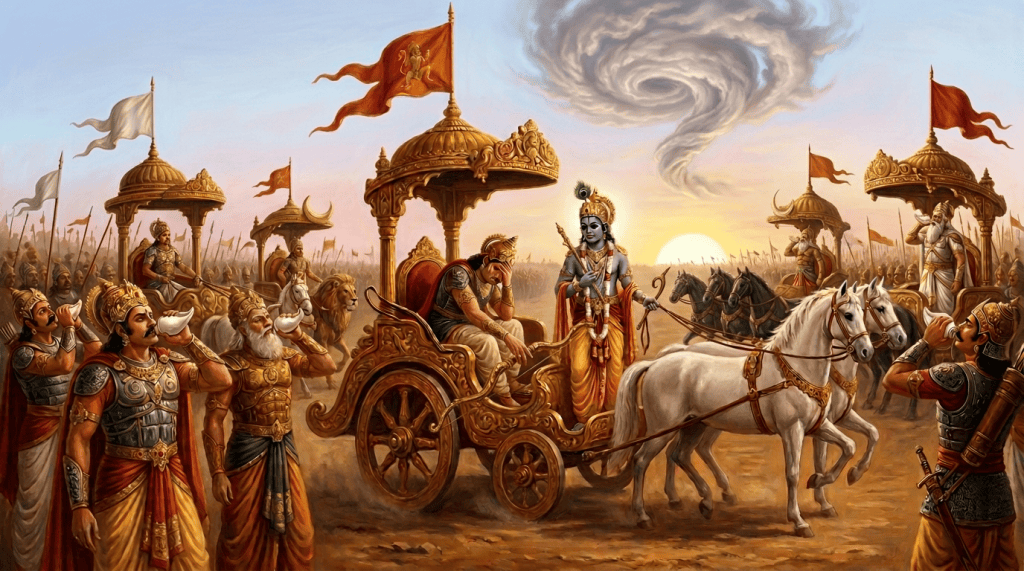
Based on Bhagavad Gita Class # 9, March 29, 2026, YouTube Video here by Satyan Chidambaran
Transcribed By: Gita Venkataramiah
Introduction
I welcome you all to the ninth class of our Bhagavad Gītā study. In this class, we will see a summary of the First Chapter that we completed in the last class, followed by a brief overview of what to expect in the Second Chapter, and then we will enter the Second Chapter -the initial portion of the Second Chapter. (Note: This transcript concludes with the summary of the First Chapter)
So, coming to the summary of the First Chapter, the First Chapter can be divided into 5 parts, and I will give you the breakup of the five parts based on the verse numbers.
- Part 1: So, the first part is from verses 1 to 20 that describes the atmosphere on the battlefield and provides the context for where the teaching of Bhagavad Gītā takes place: where and when.
- Part 2: Then, in the second part, which is from verse 21 to verse 25, we have a twist that comes up when Arjuna gets this thought that he wants to inspect the armies on both the sides. He wants to see who is there on both sides. So that is the second part.
- Part 3: Then the third part is from verses 26 to 28, which brings out Arjuna’s rāgaḥ, Arjuna’s emotional dependence.
- Part 4: Then the fourth part is from verses 29 to 35, which brings out Arjuna’s śokaḥ, or Arjuna’s sorrow.
- Part 5: The final part is the fifth part from verses 36 to 47, which is the concluding verse that brings out Arjuna’s mohaḥ.
Now, verses 31 to 35 have a mix of śokaḥ and mohaḥ. So, when we were discussing these verses, I had said that we could classify them under mohaḥ. But having looked at it, there is more of śokaḥ and less of mohaḥ in verses 31 to 35. But from verse 36 onwards, the mohaḥ aspect is very clear and therefore, verses 29 to 35 can be classified as Arjuna’s śokaḥand verses 36 to 47 can be classified as Arjuna’s mohaḥ.
Part 1: Verses 1-20: The Context – The Atmosphere on the Battlefield
So, we look at the first part, which is from verses 1 to 20, which talks about the atmosphere on the battlefield and provides the context for where and when the teaching takes place. The first chapter starts with a question by Dhṛtarāṣṭra to Sañjaya, which is not happening on the battlefield but in the palace in Hastināpura, where Dhṛtarāṣṭra asks:
धृतराष्ट्र उवाच ।
धर्मक्षेत्रे कुरुक्षेत्रे समवेता युयुत्सवः ।
मामकाः पाण्डवाश्चैव किमकुर्वत सञ्जय ॥१.१॥dhṛtarāṣṭra uvāca ।
dharmakṣetre kurukṣetre samavetā yuyutsavaḥ ।
māmakāḥ pāṇḍavāś caiva kim akurvata sañjaya ॥1.1॥
“So, what did my people and the Pāṇḍavas do on the battlefield?” This is his question.
So, in response, Sañjaya starts his narration, and then he says that Duryodhana inspected the army on the other side, and then he walks up to Droṇa and he starts to talk about the warriors on both the sides, and one of the significant verses here is that even though his army is objectively superior, he says:
अपर्याप्तं तदस्माकं बलं भीष्माभिरक्षितम् ।
पर्याप्तं त्विदमेतेषां बलं भीमाभिरक्षितम् ॥१.१०॥aparyāptaṃ tadasmākaṃ balaṃ bhīṣmābhirakṣitam ।
paryāptaṃ tvidameteṣāṃ balaṃ bhīmābhirakṣitam ॥1.10॥
So here, it brings out the fact that even though his army may be objectively superior in terms of the number of people and the number of elephants, horses, chariots, etc., the number of akṣauhiṇis, he still has this insecurity. He still has this insecurity. He feels that it is not sufficient; even though, for giving a pep talk, he may say that we have so many people, etc. So, this is because he has indulged in adharma, and anyone who has engaged in adharma can never have this internal harmony, peace, and security.
Then Bhīṣma in order to raise his spirits, in order to cheer Duryodhana, he blows his conch. And we saw that:
तस्य सञ्जनयन्हर्षं कुरुवृद्ध: पितामह: |
सिंहनादं विनद्योच्चै: शङ्खं दध्मौ प्रतापवान् ॥१.१२॥tasya sañjanayan harṣaṃ kuruvṛddhaḥ pitāmahaḥ |
siṃhanādaṃ vinadyoccaiḥ śaṅkhaṃ dadhmau pratāpavān ॥1.12॥
So Bhīṣma blows his conch after having roared like a lion because he wants to raise Duryodhana’s spirits. And then, following this, the entire Kaurava army blows their conches and beats their drums and all of that. And then the Pāṇḍavas blow their conches one by one. And all these sounds of the Pāṇḍavas’ great conches come from various directions, and these sounds, the first chapter says, “it reverberated between the earth and the sky.”
स घोषो धार्तराष्ट्राणां हृदयानि व्यदारयत् |
नभश्च पृथिवीं चैव तुमुलोऽभ्यनुनादयन् ||१.१९||sa ghoṣo dhārtarāṣṭrāṇāṃ hṛdayāni vyadārayat |
nabhaśca pṛthivīṃ caiva tumulo’bhyanunādayan ||1.19||
“So, it pierced the hearts of the sons of Dhṛtarāṣṭra”, says Sañjaya. Meaning that it created a certain panic in their hearts, which Sañjaya is indirectly indicating that the sons of Dhṛtarāṣṭra are not really a match for the Pāṇḍavas. So, this is the first part, verses 1 to 20, a summary of the first part, and then comes the second part.
Part 2: Verses 21-25: The Twist
Like we said, it starts with atha which indicates a certain turning point in verse 21 where it says:
अथ व्यवस्थितान्दृष्ट्वा धार्तराष्ट्रान् कपिध्वज: ।
प्रवृत्ते शस्त्रसम्पाते धनुरुद्यम्य पाण्डव: ॥१.२० ॥
हृषीकेशं तदा वाक्यमिदमाह महीपते ।atha vyavasthitān dṛṣṭvā dhārtarāṣṭrān kapidhvajaḥ
pravṛtte śastra-sampāte dhanur udyamya pāṇḍavaḥ ॥1.20॥
hṛṣīkeśaṃ tadā vākyam idam āha mahīpateअर्जुन उवाच |
सेनयोरुभयोर्मध्ये रथं स्थापय मेऽच्युत ॥१.२१॥arjuna uvāca
senayor ubhayor madhye rathaṃ sthāpaya me ’cyuta ॥1.21॥
So, Arjuna sees the readiness of the Kaurava army, and then he asks Kṛṣṇa to position the chariot in between the two armies so that he can see who is there on both the sides. And as commanded by Arjuna, Kṛṣṇa places the chariot in between the two armies. Kṛṣṇa had some freedom about where to position it. And Kṛṣṇa positions it in such a way that they are opposite Bhīṣma and Droṇa. And Kṛṣṇa probably did this deliberately because he knew that this may create a certain turmoil in Arjuna’s mind and then would be the chance for him to give out the teaching of the Gītā for the benefit of the entire humanity. So this is the second part from verses 21 to 25.
Part 3: Verses 26-28: Arjuna’s Rāgaḥ (Emotional Dependence)
Then from verses 26 to 28 they bring out Arjuna’s rāgaḥ or Arjuna’s emotional dependence. In verse 27 we saw:
तान्समीक्ष्य स कौन्तेय: सर्वान्बन्धूनवस्थितान् ॥१.२७॥
कृपया परयाविष्टो विषीदन्निदमब्रवीत् ।tānsamīkṣya sa kaunteya: sarvānbandhūnavasthitān ॥1.27॥
kṛpayā parayāviṣṭo viṣīdannidamabravīt ।
So, having seen sarvān bandhūn avasthitān (सर्वान् बन्धून् अवस्थितान्)-he sees his relatives and teachers, and there’s a big list of who all is there. So, he sees all these people and kṛpayā parayā āviṣṭaḥ (कृपया परया आविष्टः) -he is overpowered, gripped, seized by compassion. But as we saw, this is not the compassion that we talk about, generally speaking. But this is misplaced compassion that has arisen out of his emotional dependence upon people, objects and situations born out of an idea that I am deficient, wanting, inadequate. And therefore, for my completeness, I have to have certain people, objects and situations always around me. But then the world is unpredictable, uncontrollable, and unsustainable, and therefore no person, no object, no situation can last forever. This is a fact of life. And if one is emotionally dependent upon people, objects, and situations, then even their imaginary loss, let alone a real loss, even the imaginary loss of whatever I am emotionally dependent upon, will inevitably end in sorrow.
And therefore, this kṛpayā parayāviṣṭaḥ is really his attachment. He was overpowered by his own emotional dependence, his own attachment. And this is somewhat analogous to one person’s physical health, for example. See, if a person has a weak immune system. If the immune system of a person is weak, then the person will fall physically sick more often in the presence of infections around, there’s infection in the air or germs in the air, then the weaker the immune system, the more frequently this person will become sick.
So similarly, there is an idea of mental immunity here. So, if one has greater world dependence for one’s own well-being, the greater one depends upon for one’s own emotional well-being, the more dependence upon the world. And that is like a weakened immunity of the mind because situations are guaranteed to change, and when that happens, one will fall mentally sick.
So, this is the comparison that we can keep in mind with respect to our own physical body and how it gets sick. And similarly, the mind can also get sick more often if there’s greater emotional dependence. And therefore, Arjuna says:
दृष्ट्वेमं स्वजनं कृष्ण युयुत्सुं समुपस्थितम्॥१.२८॥
dṛṣṭvemaṃ svajanaṃ kṛṣṇa yuyutsuṃ samupasthitam ॥1.28॥
In verse 28, he uses the word svajanaṃ. These are my people. I am theirs. They are mine. He has this kind of emotional dependence. Emotionally intertwined very deeply, and therefore his ahaṃkāra and mamakāra is very evident, and therefore rāgaḥ is inevitable. Wherever mamakāra is there rāgaḥ is inevitable. This is part three, which brings out Arjuna’s rāgaḥ.
Part 4: Verses 29-35: Arjuna’s Śokaḥ (Sorrow)
Then verses 29 to 35 bring out Arjuna’s śokaḥ. So when ahaṃkāra and mamakāra is there, rāgaḥ is inevitable- emotional dependence is inevitable, and when emotional dependence, rāgaḥ is there, then śokaḥ is inevitable. And the greater the addiction, the greater the dependence upon people, objects, and situations, more will be the symptoms. More will be the symptoms.
This is somewhat similar to a person who is addicted, for example, to cigarettes or alcohol. And if now he is in a situation, if he travels, let’s say he has traveled somewhere, and that night or evening, he cannot get cigarettes or alcohol, for example, and he has to live that way for one week. Just imagine this situation. Then such a person can even start to have symptoms at the physical level. Maybe trembling in the hands; there’s going to be a certain anxiety that will I be able to live without it? And then that may express even at the physical level. So, something similar happens to Arjuna.
He says: sīdanti mama gātrāṇi (सीदन्ति मम गात्राणि)- “my limbs have become weak”. From verse 29 onwards –sīdanti mama gātrāṇi (सीदन्ति मम गात्राणि), mukhaṃ ca pariśuṣyati (मुखं च परिशुष्यति) – “my mouth has become dry”, vepathuś ca śarīre me (वेपथुश्च शरीरे मे) – “my body is having trembling”, romaharṣaś ca jāyate (रोमहर्षश्च जायते) – “my hair is standing on one end”, gāṇḍīvaṃsraṃsate hastāt (गाण्डीवं स्रंसते हस्तात्)- my bow is slipping from my hands, tvak caiva paridahyate (त्वक् चैव परिदह्यते)-“my skin is as though burning, na ca śaknomi avasthātuṃ (न च शक्नोमि अवस्थातुं) – “I am not able to stand”, bhramatīva ca me manaḥ (भ्रमतीव च मे मनः)-“my mind is as though swirling around”, nimittāni ca paśyāmi (निमित्तानि च पश्यामि)- I am seeing so many bad omens, viparītāni keśava (विपरीतानि केशव), na ca śreyo ’nupaśyāmi hatvā sva-janam āhave (न च श्रेयोऽनुपश्यामि हत्वा स्वजनमाहवे).
As we said, he is interpreting situations around him to be bad omens, and that is again indicative of a weakness of his mind, a weakness of his resolve. And then he says I don’t desire; I don’t desire this kingdom or pleasures, and what is the use of living.kiṃ bhogair jīvitena vā (किं भोगैः जीवितेन वा)- He says, “What is the use of living?”
So, he is slipping into some form of depression because he’s seeing life as being meaningless without these people. So here, we see largely an expression of Arjuna śokaḥ but there’s a mixture of traces of mohaḥ also, because all of this indicates a certain confusion also. A lack of clarity with regards to facts. He’s not being objective when he says that life will be meaningless and what is the use of the of the kingdom and all of these things because he is not being objective here. And lack of objectivity is some form of mohaḥ and therefore largely śokaḥ with traces of mohaḥ here. This is part number four.
Part 5: Verses 36-47: Arjuna’s Mohaḥ (Delusion)
But from part number five, which is from verses 36 to 47, Arjuna’s mohaḥ really becomes very, very evident. Because his dharma-adharma-vivekaḥ becomes clouded and he begins to see the entire dharma-yuddha as being adharma, which is very clearly classifiable as mohaḥ. So, he says nihatya dhārtarāṣṭrān naḥ kā prītiḥ syāt janārdana (निहत्य धार्तराष्ट्रान् नः का प्रीतिः स्यात् जनार्दन) in verse # 36,
निहत्य धार्तराष्ट्रान्न: का प्रीति: स्याज्जनार्दन ।
पापम् एव आश्रयेत् अस्मान् हत्वा एतान् आततायिनः ॥१.३६॥nihatya dhārtarāṣṭrān naḥ kā prītiḥ syāj janārdana ।
pāpam eva āśrayet asmān hatvā etān ātatāyinaḥ ॥1.36॥
So, he says that if we give this punishment to the sons of Dhṛtarāṣṭra, who he acknowledges are ātatāyis, who have committed all these six forms of crimes that we talked about. So, he acknowledges that they are ātatāyis, but he says that pāpam eva āśrayet asmān hatvā etān ātatāyinaḥ (पापम् एव आश्रयेत् अस्मान् हत्वा एतान् आततायिनः). Meaning, if we kill these people, we will only get pāpam, he says. And therefore, even though punishing an ātatāyī is really the kṣatriya dharma and if he does that, he should get puṇya, but what he is arguing is that they will get pāpa out of it. So, what is puṇya he is seeing as pāpa. And what is pāpa, which would be the omission of his duty, would be pāpa; not doing his duty would be pāpa, but then he is seeing that as puṇya. So, this indicates Arjuna’s mohaḥ, and then Arjuna now starts to justify his stand. Like we said, when the mind is confused, a person doesn’t realize that “I am confused”, then he can use his own intellect to justify his position. The intellect joins the mind and therefore now starts Arjuna’s justification of why this war is adharma.
And like we said, standalone, a lot of what Arjuna said is reasonable. There is scriptural justification for it also. But then here he is using that to justify his own position.
And therefore, Arjuna starts on the discourse where he emphasizes on the value of kula-dharma. And the importance of the family as a unit. So then, he gets into the importance of the family and the family dharmas, the practices, customs, traditions, culture, rituals, etc., and why those get lost. And if those get lost, then it will cause a lot of problems.
So, he talks about that in verse 40, where he says:
कुलक्षये प्रणश्यन्ति कुलधर्मा: सनातना: ।
धर्मे नष्टे कुलं कृत्स्नमधर्मोऽभिभवत्युत॥१.४०॥kulakṣaye praṇaśyanti kula-dharmāḥ sanātanāḥ ।
dharme naṣṭe kulaṃ ṛtsnamadharmo’bhibhavatyuta॥1.40॥
So, he’s saying that a lot of able-bodied men will be killed in this battle, and when the men die, then their families are destroyed. And when the families are destroyed, meaning the families will lose an important member of the family, and that will lead to a loss of the kula-dharma. It will lead to a loss of the kula-dharma, and therefore adharma will increase. When kula-dharma declines, then the artha-kāma pursuits of the family members are no longer guided or constrained by dharma, and the kula-dharma is gone and therefore, life becomes artha kāma pradhāna, and this would be an artha kāma pradhāna life that is not guided by dharma. Means, it will be guided by adharma and therefore adharma will increase. And when adharma will increase then he says that women will fall into improper conduct. And when women fall into improper conduct, then there will be a mix-up of the varṇas. And when there is a mix-up of the varṇas, again the pursuit of the next generation will not be guided by dharma, and therefore it will become a materialistic society whose only goals are arthaḥ and kāmaḥ and nothing else. Earn on weekdays, enjoy on weekends, and that is all there is to life. Nothing more. So, one will one will degenerate into that kind of society. And when that happens, then the people of the present generation who are not following dharma they will go to naraka. And because they have given up all the rituals, including the post-death rituals, their ancestors, he says, will also fall. Their ancestors will also suffer, and therefore Arjuna says that this entire war is adharma. And therefore, in verse 46, which is the last thing that Arjuna says. He says,
यदि माम् अप्रतीकारम् अशस्त्रं शस्त्रपाणयः ।
धार्तराष्ट्रा रणे हन्युः तन् मे क्षेमतरं भवेत् ॥१.४६॥yadi mām apratīkāram aśastraṃ śastra-pāṇayaḥ ।
dhārtarāṣṭrā raṇe hanyuḥ tan me kṣemataraṃ bhavet ॥1.46॥
That if I am unarmed and I don’t offer any resistance, and if the sons of Dhṛtarāṣṭra who are armed – if they were to kill me, then that would be better than engaging in this war, which is adharma. That is the last statement that Arjuna makes.
And then Sañjaya says,
सञ्जय उवाच ।
एवमुक्त्वार्जुन: सङ्ख्ये रथोपस्थ उपाविशत् ।
विसृज्य सशरं चापं शोकसंविग्नमानस: ॥१.४७॥sañjaya uvāca ।
evam uktvārjunaḥ saṅkhye rathopastha upāviśat ।
visṛjya saśaraṃ cāpaṃ śoka-saṃvigna-mānasaḥ ॥1.47॥
So, Arjuna then sits down on the chariot in the middle of the battlefield, having dropped his bow and arrow. And dropping his bow and arrow is indicative of svadharma parityāgaḥ. And therefore, we have seen Arjuna goes through all the symptoms of rāgaḥ, śokaḥ, mohaḥ, culminating in svadharma parityāgaḥ.
So, he has been completely taken over by all these symptoms of the disease of saṃsāraḥ. This is what the first chapter is indicating. So, as we have seen, the message that we should extract from the first chapter is that when a person is suffering from some disease, then the person experiences the disease in the form of some symptoms, some distressing symptoms. But he doesn’t know the specifics of the disease or its root cause or its remedy or treatment. He doesn’t know that. So, for some time he may try some self-medication, or he may try symptomatic cures, etc. But this self- medication and symptomatic cures and all of that, they leave the root cause untouched, and as long as the root cause is not addressed the symptom will keep appearing in different forms again and again. And therefore, at some point he has to acknowledge his own helplessness in treating the disease and approach an expert who understands the disease in terms of the root cause and its treatment.
Arjuna Discovers the Distressing Symptoms of the Disease of Samsāra
So, in the first chapter, Arjuna discovers the distressing symptoms of the disease of saṃsāraḥ in terms of rāgaḥ, śokaḥ and mohaḥ. In terms of emotional dependence, his sorrow and confusion.
So now, the question is, “then what about the root cause and the treatment?” So that is going to be revealed in Chapter 2. Chapter 2 – the root cause and the treatment will be taught by Śrī Kṛṣṇa. But before that, certain other things have to happen. So right now, Arjuna has discovered the disease in terms of the symptoms, but Arjuna is yet to acknowledge his own helplessness. So, Arjuna has to discover his own helplessness. That’s the second stage after the discovery of the symptoms – distressing symptoms. One has to discover one’s own helplessness.
And then the third stage is that Arjuna has to then approach an expert who is there in the form of Śrī Kṛṣṇa, to whom he has to surrender. So, there are two more things that have to happen after the discovery of the distressing symptoms.
1. Discovery of his own helplessness
2. And then surrender to Bhagavān Kṛṣṇa
So, much like a patient who has undergone all these distressing symptoms and having discovered at some point, discovered his helplessness, goes to a doctor and says that I am not able to deal with this disease. Now I hand myself over to you and now whatever treatment you are going to say I am going to follow it.
So, this kind of an attitude has to come about, and then Śrī Kṛṣṇa will be in a position to suggest the root cause and the remedy treatment, etc.
Arjuna’s Problem is not just Arjuna’s Problem – it is a Universal Human Problem, and also My Problem
And then the important message that we have to extract from the first chapter is that this is not just Arjuna’s problem. What we are seeing here is a specific instance of the fundamental human problem. It’s a universal human problem. And being a universal human problem, it is also “my problem”. Because in case of Arjuna, he was dependent upon certain people, objects, and situations. But in case of every human being, including “myself”, I have to see that I have got all of these attachments and dependencies, and that will inevitably result in śokaḥ and mohaḥ, and therefore this is a fundamental human problem which is also “my problem”. And when I appreciate this, only then that remedy that Bhagavān Kṛṣṇa talks about will be a remedy not just for Arjuna but for me also.
So, with this, we conclude our discussion of the first chapter.

