
- Introduction
- The Problem, as Presented by Vedānta
- The Awakening of the Tenth Man
- The Jīva’s Search for Mokṣa Compared to the Tenth Man’s Search
- Accomplishing the Accomplished
- Correct Diagnosis: When Ignorance is the Problem, Knowledge Alone is the Solution
- Seven Stages of Progress in the Case of the Tenth Man (and the Jīva)
- The Problem is not the Lack of Experience but the Lack of Knowledge
- The Mumukṣu (Seeker of Mokṣa) Needs to be Converted to a Jijñāsu (Seeker of Knowledge)
सदाशिवसमारम्भां शङ्कराचार्यमध्यमाम् ।
अस्मदाचार्य पर्यन्तां वन्दे गुरुपरम्पराम् ॥
sadāśivasamārambhāṃ śaṅkarācāryamadhyamām
asmadācāryaparyantāṃ vande guruparamparām
I salute the entire unbroken lineage of teachers (of ātmavidyā) starting with sadāśiva, with śaṅkarācārya in the middle, all the way up to my ācārya.
Introduction
In the first topic, we examined the four human goals called puruṣārthas namely artha, kāma, dharma, and mokṣa. We also saw that a human being, seeing himself as limited and lacking, compulsively pursues the first three puruṣārthas for the sake of security and happiness, but the fulfillment gained is temporary at best. We also saw how a person who pursues artha and kāma with dharma engaging in karma yoga (including niṣkāma karmas) gradually grows and gains citta-śuddhi or purity of mind. Such a person with citta-śuddhi sees the limitations (dukhamiśritattvam, atṛptikaratvam, and bandhakatvam) of artha, kāma, and dharma puruṣārthas.
A person with citta-śuddhi reasons thus: “Because of these limitations, nothing in the domain of artha, kāma, and dharma can give me the lasting fulfillment that I seek. Just pursuing more of the same is pointless. Is there any pursuit at all that can give me lasting fulfillment? “Fundamental questions such as “Who am I?”, “What is the purpose of life?”, “Who is God?” etc., faint murmurs that were earlier lost in the din of pursuit of the three puruṣārthas, and perhaps brushed aside as uninteresting questions, now resurface in one’s mind with a stronger voice demanding answers with greater urgency.
Someone at this juncture who has already been exposed to the Vedas and Vedānta probably has an easier time transitioning to Vedānta to seek answers to these questions. However, for many with no such exposure, such a period of disillusionment may lead to exploration. It is a period in which the person is quite vulnerable. Not knowing where to start, one may be willing to explore anything that promises fulfillment. One’s past karmas (which may or may not be favorable) have a significant role to play in determining the direction that one takes at this point to gain fulfillment.
Understanding the nature of the problem as presented by Vedānta is indispensable for providing much-needed clarity regarding how one should go about discovering the fulfillment that one has been seeking. To this effect, we will study the problem that one is trying to solve and will see what Vedānta has to say about it.
The Problem, as Presented by Vedānta
Questioning the Conclusion that I am a Limited Being
Vedānta starts by poking a hole in the conclusion that one generally takes to be axiomatic and unshakeable. The conclusion that all human beings take for granted is that “I am a limited being, lacking in security and happiness”.
Vedānta first points out that this conclusion is unsound. How so? For this, one needs to further analyze one’s experiences. We will start with an example first to illustrate the point.
I experience the sun rising in the east and setting in the west. If I take my experience at face value, then I will conclude that the sun goes around the earth. However, one becomes more informed if one travels near the poles. Then one sees a contradictory experience that the sun goes around in a circle in the sky. Now, given these contradictory observations, what is the true relationship between the sun and the earth? Only Knowledge can reconcile these seemingly contradictory experiences in the understanding that it is the earth that rotates on its axis. In light of this knowledge, both experiences of the movement of the sun are reduced to appearances based on where one is located on earth. The reality is something entirely different and knowledge of that explains both the experiences as an appearance.
Similarly, I experience my incompleteness where I sense my lack of security and happiness. However, there are also moments when I feel complete, free from lack, and don’t seek any change in my situation. This is especially so when I have just accomplished something I desired, or when I hear a good joke that makes me forget everything for a few moments and I have a hearty laugh. Now, this should make me question what the reality of myself is. How should I know myself? Is the incomplete-wanting-lacking self the reality and the occasional experience of completeness an appearance? Or is the complete-fulfilled self the reality and the largely persistent sense of lack an appearance? This needs to be inquired into. Until this has been investigated properly, I should hold off on jumping to the conclusion that I am fundamentally a limited lacking being.
What I want is Freedom from Lack
Vedānta also points out that I can sense a lack only when I also have some insight into what not lacking is, which then serves as the reference point. Without a reference point of what satisfaction is, it is impossible to be dissatisfied with something. Similarly, without the reference point of my experiences where I have no lack, I cannot say at other times that I lack. That occasional experience of not lacking anything that I have experienced now and then is what makes me pursue freedom from this lack. Thus, what I am really pursuing is not an object given that I lack, but freedom from the lack itself! The pursuits of artha, kāma, and dharma don’t help me free myself from the lack as those just accumulate accomplishments keeping the lacking, limited, incomplete sense of self intact.
The Search For Freedom from Lack is a Natural Urge
All human desires can be classified into natural and cultivated desires. Desires that are a result of my social conditioning, a result of my upbringing, or a result of an advertisement that I saw on TV are cultivated desires. The desire for a Mercedes Benz or a BMW is cultivated, as is the desire to wear a tie. On the other hand, hunger and thirst are not cultivated desires. They are natural desires.
The desire for freedom from my lack (of security and happiness) is a very basic urge and is the primitive driving force behind all my pursuits of artha, kāma, and dharma. It is not a cultivated desire.
Only a cultivated desire can be dropped. For example, if one desires a BMW, but later suffers losses in one’s business, one may drop the desire to own it. However, a natural desire like hunger, thirst, etc. cannot be dropped. So also, it is not possible to drop this desire for freedom from lack. Hence, I cannot be comfortable with a limited self as my urge to free myself of lack is inherent and cannot be dropped. I need to do something about it, and I don’t know what else to do other than pursue artha, kāma, and dharma. But one eventually discovers after running endlessly after those goals that it is futile. What one is really seeking from those pursuits is freedom from all lacking, which is nothing but mokṣa. Thus, this desire for mokṣa is the most primitive underlying urge behind all artha, kāma, and dharma pursuits. It is certainly not a cultivated desire, but a most basic natural urge.
All Natural Desires Have a Solution
This creation we see around us seems to have a solution for all of my natural desires. If I feel hungry, there is a possibility of getting food. If I feel thirsty, there is a possibility of getting water. It would indeed be a very cruel creation if there was a natural desire with no way to address it. Therefore, assuming that this isn’t a cruel creation, there must be a solution to fulfill the desire for mokṣa in this creation.
Now, let us take this to the next step: If indeed there is a solution for mokṣa, the desire for freedom from all lack and limitations, or in other words, the desire for limitlessness, but I am really lacking and limited, to begin with, I could never become limitless. A fundamentally limited entity can never become limitless no matter what one does for each action produces a limited result and a sum of limited results can never lead one to limitlessness. It follows that if I were really limited, that would mean that my desire for limitlessness can never be fulfilled. But that would then violate our premise that the desire for mokṣa has a solution.
How Do I Gain Freedom from Lack?
Therefore, if the desire for mokṣa has a solution, the only other possibility I am left with is that I am in reality free of all lack, I am limitless already, and I just don’t know the fact that I am limitless. Then indeed the problem would just be one of ignorance….then I would have a way out. I just need to remove my ignorance and I would then know myself as already being limitless.
Vedānta confirms that this is indeed the case! According to Vedānta, I am already limitless. I just don’t know that I am limitless. Thus, in the vision of Vedānta, my search to be free of any lack, limitations, or in other words, my search for limitlessness is due to Self-Ignorance. All I need to do is remove this Self-Ignorance of my limitless nature and know myself as limitless!
When one doesn’t see a rope as a rope, then one inevitably makes a mistake. One takes it to be a snake. In other words, one superimposes a snake on the rope. Following the mistake, futile actions like screaming, running away from the snake, and beating the snake invariably follow. The causal chain involved here is ignorance –> superimposition –> action. This is termed as avidyā –> adhyāsa –> karma.
The precondition for the mistake to occur is that one should have a locus for the mistake, and one should have a basis for the mistake. The rope serves as the locus for the mistake. Not knowing the rope as a rope provides the basis for the mistake. If one doesn’t see the rope at all, say in total darkness, there is no locus for a mistake. On the other hand, in total daylight, when one sees the rope well and clearly as a rope, there is no basis for a mistake. But during dusk, when one sees the rope partially, there is both a locus and a basis for the mistake to occur.
How does this relate to the human pursuit of fulfillment?
Vedānta points out that human beings are self-aware beings. As a result of more advanced intellects, human beings are keenly aware of a sense of self. Thus, in the sense of self, we have a locus for a mistake to occur. In the vision of Vedanta, the self is free of all lack, or in other words, limitless. But as the self is not known clearly for what it is, as limitless, there is also a basis for a mistake. This Self-Ignorance causes a superimposition that the self is limited, or in other words “I am a limited being lacking in security and happiness”. This is then followed by futile actions to remove the limitations associated with the limited self with the pursuit of artha, kāma, and dharma. However, despite all those accomplishments, the superimposition that “I am a limited, lacking being” continues to persist as it is a result of Self-Ignorance, which is left untouched and intact by my extroverted pursuits. A highly decorated broomstick remains a broomstick, no matter how well embellished it is. Similarly, because you are limited in your flawed vision, you continue to see yourself as limited despite all your artha, kāma, and dharma accomplishments. My flawed vision of myself is never corrected because of these accomplishments. It persists despite any number of such accomplishments. Hence, I continue to remain a miserable, limited, incomplete, lacking, and wanting person in my assessment.
Thus, the real problem to be solved is not what you do given that you are lacking. Instead, you seeing yourself as lacking is the real problem! Vedānta points out that I have been trying to solve the wrong problem all along! Once I take the problem to be “What do I need to do given that I am lacking?”, I get entrapped in a futile and endless pursuit of artha, kāma, and dharma. The only way to end my entrapment in futile pursuits is to see that I have been trying to solve the wrong problem all along. The problem to be really solved instead is that “I see myself as lacking when I am really not”. Only then can one appreciate that one requires an entirely different pursuit to solve that problem.
The Awakening of the Tenth Man
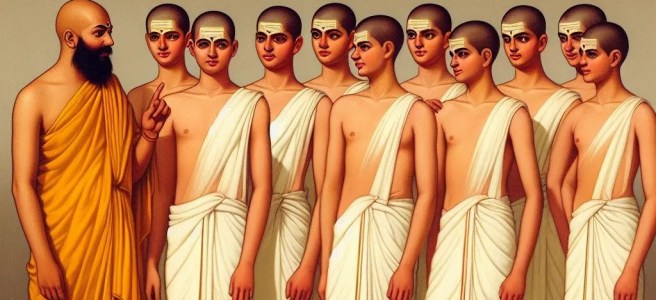
A long time ago, in ancient India, there was a Gurukulam on the banks of a river. Several students resided there and learnt the Vedas from their Guru. All of them were very devoted to their Guru. As we all know, the routine in a Gurukulam is very stringent. The students were working very hard at their learning.
After a long period of continuous study lasting several months without any holidays, the boys were desirous of a break. They approached their Guru and asked him for permission to go on a day trip to the open fields across the river where they could run around and play. The Guru was a bit hesitant. He could see that the boys would be happier with a break, but then he was also concerned about their safety.
The Guru thought about it and summoned the eldest of them and asked him if he would take responsibility for everyone’s safety. The boy happily agreed and was appointed the captain of the team that was to go on their little expedition.
The next day, the boys got up early, and all excited. They all ate their modest porridge meal and set off on their trip. There was one catch though. They had to swim across the river. All of them were excellent swimmers. The captain nevertheless being extra careful wanted to make sure that everyone crossed over safely. He made all the boys stand in a file and counted them one by one. He counted that there were ten of them in all. They dove into the river one after another amidst laughter and chattering.
They had now been swimming for a few minutes led by the captain who was ahead of them all. The river waters were a bit choppier than usual, which worried him somewhat. Once in a while, he looked back over his shoulder to make sure that all of them were safe. As he approached the other bank and clambered out, he was eager to count them again for being devoted to his Guru, he wanted to make sure that all of them were safe.
As the boys started emerging from the waters, he started to count them…one two three…but then some of the boys started running around yelling as they were happy to be in the large open fields….and then he started to count again….and by this time as the last boy had also emerged, he counted them all…one two..three…seven…eight…nine…..what? this couldn’t be. He had only counted nine. Hurriedly he counted them again, and then again….but he could only spot nine. Something was wrong! He wanted to make sure that he was doing it right. He called the next senior student and asked him to count as well. To the captain’s dismay, the boy he had summoned also counted and confirmed that there were only nine! Now he was convinced that the tenth boy had gone missing. His Guru’s image loomed large in his mind, and he recalled the assurance he had given his Guru that he would take care of the safety of all the boys. He did not know how he would face his Guru….tears started to roll down his cheek. The second in command, seeing his senior break down, followed suit. Soon some of the other boys noticed this and as the word spread about the missing tenth boy, and as the other boys also confirmed their counts, very soon there were a bunch of boys wailing and inconsolable.
The captain tried to rein in his emotions and tried hard to look around for the lost tenth boy. He went back to the shore and hoped that the tenth boy would emerge from the waters much like the others did. But there was no sign. Then he searched for him in a small clump of trees nearby but there was no sign of him there either. In desperation, he banged his head repeatedly against a tree resulting in a bump on his forehead that was bleeding.
An elderly man who was passing by saw the commotion and stopped to inquire. When he heard about the lost tenth boy, he quickly counted and immediately figured out what was going on. He called the captain and told him: “The tenth boy is there. I can show him to you”. As even the stranger uttered these words, there was a sign of relief on the captain’s face. He quickly wiped his tears and said: “What??”. There was some disbelief in the stranger’s words but then he had nothing to lose by hearing him out. He quickly asked: “O elderly one, I have been looking for him everywhere, can you please show him to me?”. The stranger confidently replied: “Yes, I will do so” as even he wiped off some of the blood from the bump on the captain’s face. The captain found the kind elderly man’s words comforting and was now willing to listen to what he had to say.
Then, the elderly man, having ensured that the boys were sufficiently calmed down, made them stand in a line. With the youngest of them at one end and the captain at the other end, he walked past each boy and counted “One, Two, Three, Four, Five, Six, Seven, Eight, Nine”. When he approached the captain, the puzzled captain said, “Where is the tenth man? I still don’t see him!”. To which the stranger replied with a smile, “You, my dear, are the Tenth!!”.1
As even the captain heard the words, he saw what he had been missing. He had just forgotten to count himself! His search had now ended with finality. His sense of incompleteness vanished forever as he awoke to his real nature as the tenth boy! All of his problems evaporated. He was joyful again.
The Jīva’s Search for Mokṣa Compared to the Tenth Man’s Search
The jīva’s search for mokṣa is a search for fullness, completeness, and limitlessness. According to Vedānta, this search is similar to that of the tenth man’s search for the tenth man! Vedānta tells us that the jīva is already full, complete, and limitless. The jīva just needs to know his own accomplished reality of already being full, complete, and unlimited that he is just not aware of. In his ignorance, he takes himself to be limited and then looks around for that limitlessness. He is not going to find that limitlessness if he is ‘looking for it’ much like the tenth man would never find himself if he went ‘looking for the tenth man’. Much like the tenth man was told and shown “You are the tenth”, similarly, the jīva needs to stop his search for fulfillment by chasing limited goals and he needs to be told and shown that “You are That”2, the understanding of which shows him his limitlessness. Only then, the jīva can awaken to his reality that is already accomplished. It is very much a case of accomplishing the already accomplished!
Accomplishing the Accomplished
In most cases, when we have really lost something we had, or we need to gain something that we really do not have, we need to act. Actions are needed to accomplish something that is not yet accomplished. However, there are some cases we encounter less often in our day-to-day lives such as spectacles are on one’s own head but due to forgetfulness one looks for it around the house, or the keys are in my pocket and still, I look for them in the drawers and elsewhere, or the necklace is on the lady’s neck, but she thinks that she has lost it and starts to look for it. In all of these cases, the ‘search’ itself is due to ignorance. In all these cases, if the ‘search’ continues, it is an amplification and reinforcement of the ignorance. It takes one away from where one can really find what one is looking for. Such an invalid search can only end with Knowledge – Knowledge that the search is invalid, that what is being sought is already accomplished! Action is needed to accomplish that which is not accomplished, but only knowledge can accomplish that which is already accomplished!
How does one gain this knowledge? The answer is that one needs to know this through words! Just words? Yes, just words! Just as the words ‘You are the Tenth’ awakened the tenth man to his reality as the tenth man, an understanding of the words of Vedānta can awaken the jīva to his reality as being limitless, something that is already accomplished, and just was not known.
Correct Diagnosis: When Ignorance is the Problem, Knowledge Alone is the Solution
We would have heard of numerous cases in our daily lives of what happens when a problem is not diagnosed properly. If there is a disease, and if the root cause is not identified, one may run from pillar to post to get some relief, but the disease keeps resurfacing in different shapes and forms. Some so-called cures might just address the symptoms, which may provide some temporary relief. But then, as long as the root cause is not addressed, the problem keeps resurfacing again and again. Engineers too would be well aware that identifying the root cause of a problem in systems, and fixing the root cause, is critical to ensuring that the reported problem does not recur.
Imagine what would have happened had the passerby not told the tenth man that he was indeed the tenth man he was looking for. The tenth man would have looked in the waters, he would have looked in the forests nearby, he may have expanded his search in a larger area and even looked underwater….there is no dearth of possibilities of what he might have done. Desiring a break from the search, he might have tried to calm himself by meditating. Or perhaps by sleeping. Or perhaps by playing a game with the others to get his mind off the search. But when he awakens from sleep or ends his meditation, or when his engrossment with the game ends, which are all nothing but palliatives, he would still have had the conclusion that the tenth man is missing and that he should find him. He would thus have continued his search endlessly.
In the vision of Vedānta, the jīva is doing exactly that. The jīva has not diagnosed the root cause of his sense of limitation. The root cause of the sense of limitation is ignorance of the fact that he is already unlimited. He then takes himself to be limited and then tries to attain freedom from the limitations through artha, kāma, and dharma accomplishments which are all but limited. Nothing that is accomplished can really make him become unlimited. At best, they may make him forget his sense of limitation for a little while, much like the palliatives that the tenth man might have engaged in. But his sense of limitation keeps coming back, and he keeps repeating his fruitless actions to try to remove his sense of limitation. The various accomplishments are only addressing the symptoms of the disease but not the root cause of the disease itself. The disease is Self-Ignorance. The cure then is Self-Knowledge and Self-Knowledge only.
Seven Stages of Progress in the Case of the Tenth Man (and the Jīva)
Vidyāraṇya narrates the story of the tenth man in Pañcadaśī 7.23-7.27. Vidyāraṇya mentions these seven stages and then follows a discussion on them
अज्ञानमावृतिस्तद्वद्विक्षेपश्च परोक्षधीः ।
अपरोक्षमतिः शोकमोक्षस्तृप्तिर्निरङ्कुशा ||
ajñānamāvṛtistadvadvikṣepaśca parokṣadhīḥ
aparokṣamatiḥ śokamokṣastṛptirniraṅkuśā
These are the seven stages of a Jīva: ignorance, covering of what is, projection of what is not, indirect knowledge, direct knowledge, freedom from sorrow, and limitless fulfillment.
Pañcadaśī 7.33
In the case of the tenth man, we can see seven stages of progress until his complete fulfillment. In the first stage, the tenth man is ignorant of his own status as the tenth man. In the second stage, he assumes that the tenth man is missing. In the third stage commences the fruitless search for the tenth man in which there is despair. In the fourth stage, he meets the stranger who calms him down and tells him that the tenth man is indeed there. In the fifth stage, the stranger eventually informs him, “You are the Tenth!”, and then he, at last, knows that he himself is indeed the tenth man that he has been looking for. When he understands the stranger’s words, in the sixth stage, he is liberated from his sorrow, and in the seventh stage, he finds joy and fulfillment.
Similarly, in the case of the Jīva, in the first stage, there is ignorance of his own limitless nature. In the second stage, he takes himself to be limited Jīva. In the third stage, he tries to address his limitations by pursuing artha, kāma, and dharma. At some point, he discovers that this is not working. There is despair. In the fourth stage, he meets his Guru who tells him that there is Brahman, the cause of the universe, that is indeed limitless. In the fifth stage, once his mind is prepared, the Guru tells him that the limitless Brahman that he is looking for is none other than himself: “You are That”. An understanding of these words removes his sorrow in the sixth stage. In the seventh stage, he finds limitless joy.
In the fourth stage, the tenth man got Indirect Knowledge (parokṣa jñānam) when the passerby told him: “The Tenth man is”. Similarly, the fourth stage, in which the student understands “Brahman is”, is called Indirect Knowledge (parokṣa jñānam).
In the fifth stage, the tenth man got Direct Knowledge (aparokṣa jñānam) when the passerby told him: “You are the Tenth!” and the tenth man understands “I am the Tenth man!”. Similarly, the fifth stage in which the student with a prepared mind is told “You are That” and the student understands “I am that Brahman” is called Direct Knowledge (aparokṣa jñānam).
Both parokṣa jñānam and aparokṣa jñānam were conveyed by the words of the stranger and understood by the tenth man. Similarly, the words of Vedānta and the Guru communicate both the parokṣa jñānam and aparokṣa jñānam that are understood by the student Jīva.
The Problem is not the Lack of Experience but the Lack of Knowledge
Going back to the tenth man story, the problem that the tenth man had was not a lack of experience of the tenth man. He was experiencing the tenth man (who is none other than himself) all the time. He was just lacking the knowledge that what he was already experiencing was the tenth man that he was looking for.
In much the same way, we all have an experience of our Self which we refer to as ‘I’. What we lack is the knowledge that the Self that is already experienced is indeed that limitless Brahman. Due to avidyā (Self-Ignorance) and adhyāsa (resultant superimposition), we take our Self to be the limited jīva and we suffer much like the tenth man in search of the tenth man. Thus, what one needs is not a new experience of the Self, but introductory words that introduce oneself to oneself as limitless Brahman much like the tenth man was introduced to himself as the tenth man! And in a prepared mind, such introductory words produce direct knowledge that is liberating3.
The Mumukṣu (Seeker of Mokṣa) Needs to be Converted to a Jijñāsu (Seeker of Knowledge)
In summary, in the vision of Vedānta, the seeker of artha, kāma, and dharma is also really seeking freedom from all lack, he is also really seeking limitlessness. Thus, he is also seeking mokṣa only, but without knowing that is what he is seeking. Such a seeker is not only Self-Ignorant but also deluded. Deluded into thinking that these other pursuits can yield what he is really seeking. Only a few who gain the needed maturity can see clearly that all the results of these pursuits, being inherently limited, cannot lead one to the limitlessness that one is seeking. The mature seeker then begins to seek this limitlessness directly with the pursuit of mokṣa. The seeker of mokṣa is thus, no doubt, more mature, than the seekers of artha, kāma, and dharma. He is now seeking the limitlessness directly, not through artha, kāma, and dharma. However, the seeker of mokṣa is seeking limitlessness without knowing that he is limitless already. He is therefore still Self-Ignorant.
Thus, The Śvetāśvatara Upaniṣad cheekily declares:
यदा चर्मवदाकाशं वेष्टयिष्यन्ति मानवाः ।
तदा देवमविज्ञाय दुःखस्यान्तो भविष्यति ॥
yadā carmavadākāśaṃ veṣṭayiṣyanti mānavāḥ
tadā devamavijñāya duḥkhasyānto bhaviṣyati
If men could roll up space like hide, only then can misery end without Self-Knowledge
Śvetāśvatara Upaniṣad 6.20
The Māṇḍūkya Upaniṣad states:
स आत्मा स विज्ञेयः
sa ātmā sa vijñeyaḥ
That Ātmā (Self) should be known.
Māṇḍūkya Upaniṣad 7
The Chāndogya Upaniṣad says:
तरति शोकम् आत्मवित्
tarati śokam ātmavit
The knower of Ātmā (the Self) transcends all sorrow.
Chāndogya Upaniṣad 7.1.3
The Vivekacūḍāmaṇi declares:
वदन्तु शास्त्राणि यजन्तु देवान् कुर्वन्तु कर्माणि भजन्तु देवताः ।
आत्मैक्यबोधेन विना विमुक्तिः न सिध्यति ब्रह्मशतान्तरेऽपि ॥
vadantu śāstrāṇi yajantu devān kurvantu karmāṇi bhajantu devatāḥ
ātmaikyabodhena vinā vimuktiḥ na sidhyati brahmaśatāntare’pi
One may speak eloquently on the scriptures, one may propitiate the devas, one may perform rituals, and one may worship various Gods. However, without the knowledge of the one Ātmā (the Self), liberation (from samsāra) is impossible, not even in one hundred lifetimes of Brahma!
Vivekacūḍāmaṇi 6
चित्तस्य शुद्धये कर्म न तु वस्तूपलभ्यते ।
वस्तुसिद्धिर्विचारेण न किञ्चित्कर्मकोटिभि: ॥
cittasya śuddhaye karma na tu vastūpalabhyate
vastusiddhirvicāreṇa na kiñcitkarmakoṭibhiḥ
Actions are meant for the purification of the mind, not for Self-Knowledge, Mokṣa. Mokṣa can only be attained by Ātma vicāra (enquiring into the Self and gaining Self-Knowledge), never even by the performance of crores of actions.
Vivekacūḍāmaṇi 11
Therefore, the mumukṣu (seeker of mokṣa) must be converted into a jijñāsu (seeker of knowledge), or else the search will never fructify and will continue endlessly.
Therefore, according to Vedānta, the mumukṣu, the seeker of mokṣa, having turned into a jijñāsu, a seeker of knowledge, abandoning commitment to actions4 meant for accomplishing the un-accomplished, should instead commit himself to gaining knowledge of himself as he already is, which alone can accomplish that absolute fulfillment which is already accomplished.
The next question that naturally follows is how does one know oneself as one already is? What means does one use to gain this knowledge of oneself? We will examine that question in the next topic.
FOOTNOTES
[6] Commitment to actions may still be required, not for the purpose of gaining fulfilment, but for the purpose of karma-yoga (including niṣkāma karmas) for gaining chitta–shuddhi, which is an aid to the pursuit of knowledge.
- दशमस्त्वमसि
Daśamastvamasi
You are the tenth! ↩︎ - तत्त्वमसि
tattvamasi
‘You are That!’ is one of the four mahāvākyas (sentences that assert the identity of the jīva and Īśvara) ↩︎ - Vidyāraṇya says in Pañcadaśī 7.70
ब्रह्मापरोक्ष्यसिध्यर्थम् महावाक्यमितीरितम् ।
वाक्यवृत्तावतो ब्रह्मापरोक्ष्ये विमतिर्नहि ॥
brahmāparokṣyasidhyartham mahāvākyamitīritam ।
vākyavṛttāvato brahmāparokṣye vimatirnahi ॥7.70
The mahāvākyam is required for the attainment of the direct knowledge of Brahman, thus it is said in vākyavṛtti (by śaṅkarācārya). Thus, there is no doubt about this. ↩︎ - Commitment to actions may still be required, not for the purpose of gaining fulfilment, but for the purpose of karma-yoga (including niṣkāma karmas) for gaining chitta–shuddhi, which is an aid to the pursuit of knowledge. ↩︎

 Advaita Drishti