
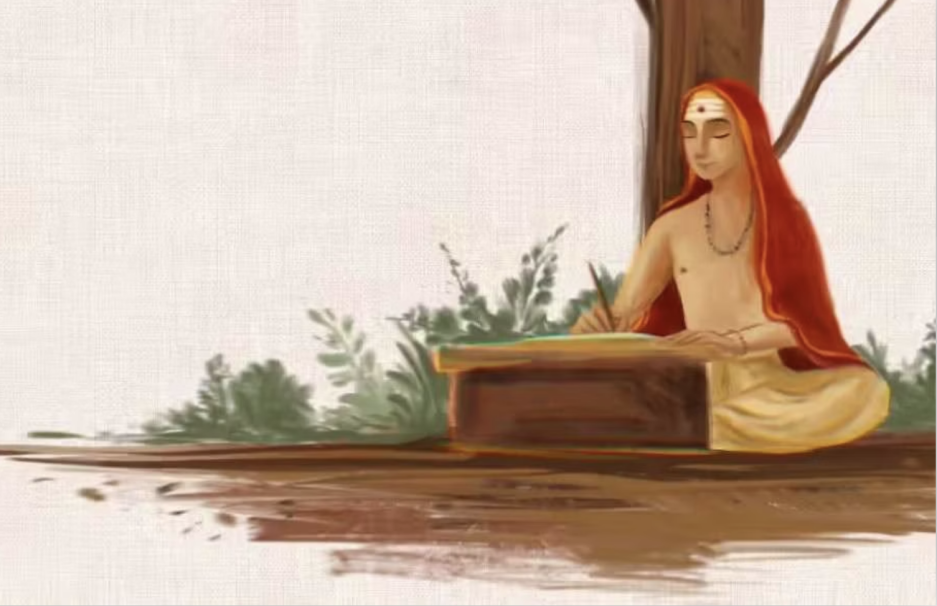

सदाशिवसमारम्भां शङ्कराचार्यमध्यमाम् ।
अस्मदाचार्य पर्यन्तां वन्दे गुरुपरम्पराम् ॥
sadāśivasamārambhāṃ śaṅkarācāryamadhyamām
asmadācāryaparyantāṃ vande guruparamparāmI salute the entire unbroken lineage of teachers (of ātmavidyā) starting with sadāśiva, with śaṅkarācārya in the middle, all the way up to my ācārya.
Introduction
The word puruṣārtha means that which is sought by human beings1. In short, they are human goals. Animals or plants do not have such goals as they are driven by instinct. Humans have several things in common with animals, but an advanced intellect is unique to humans only2. Humans can use this intellect to plan, prioritize, and achieve their goals. The Vedas classify puruṣārthas as fourfold:
- Artha
- Kāma
- Dharma
- Mokṣa
We will briefly look at each one. We will first study the first three puruṣārthas, understand their limitations, and then come to mokṣa, the fourth puruṣārtha.
Artha
artha puruṣārtha refers to all the things that make a human being feel secure. The pursuit of things needed to survive comes under this category: one needs food, clothing, and shelter. But it doesn’t stop there. We need to secure food until next week, so we buy a refrigerator. We need to secure the refrigerator, so we buy a stabilizer for the refrigerator. As we can see, we secure the things that we need to secure ourselves. And we secure the things that we need to secure the things that we need to secure ourselves. We need to secure our clothing. So, we buy a washing machine. But then we need to secure the washing machine, so we buy an extended warranty. We need to buy a house. We get a loan to secure a house. Then we refinance the loan. Then, we need to maintain the house. We need to insure the house against fires or earthquakes. For all this, one needs to continue to earn. For that, we get a job. We need to commute to earn, so we buy a car, and then we need insurance for the car and regular maintenance for the car. Health is another area that one needs to constantly work on to feel secure. And of course, we need to insure our health. We need to secure our children. So, we educate them well. And then perhaps secure their future by planning to leave them something. We also need to secure our savings against inflation to secure our retirement and old age. All these acquisitions need to be maintained and replaced or renewed as needed. Every new acquisition involves research, comparative shopping, etc. As you can see, the list of goals here is large and all this takes up a large part of a human being’s effort and time.
Kāma
kāma refers to sense gratification and entertainment. People in poverty who have difficulties in accomplishing artha-related goals only have time for some simple sense pleasures that are free or easy to afford. But once artha puruṣārtha is taken care of to some extent, one has time to enjoy life further. One earns on weekdays and enjoys on weekends. I buy a big-screen TV and a home theater system, Netflix, and Amazon Prime with 4k…or perhaps 8k video! Music, concerts, dancing, socializing, watching sports, etc. all come under this category. And then there is wanderlust. One goes on tours to visit other places and to foreign lands to get newer experiences. Also, some of the same goals under the artha category begin to fall under kāma if they are not needed for security but instead are there for pleasure and entertainment: specialty food, designer clothing, and accessories, a vacation home, expensive jewelry, cars, etc. All of this comes under kāma.
Dharma
The majority of the human beings in the world are just busy with artha and kāma. They do not know that there is anything more in life worth pursuing and they don’t seem to care either They are just materialists.
However, some cultures and religions encourage their followers to look beyond artha and kāma. This is especially true in sanātana dharma which is based on the Vedas. The Vedic culture encourages dharma-related goals. What is dharma as a puruṣārtha? To understand this, one requires śraddhā in the Vedas.
The Vedas teach that actions that we do have consequences: they generate karma: either good or bad. Each one of us has an intuitive understanding of what is a right act or wrong action. In general, whatever I want others to do to me (e.g., I want to be treated well, etc.) is what the others also naturally expect from me. Hence, those are the acts I should do to others. And whatever I don’t want others to do to me, I should not do to others (e.g., hurt, steal, or tell a lie). I know this without anyone teaching me this. This is called sāmānya dharma – general dharma that the Veda expects everyone to follow.
Then there are specific duties that each of us has with regard to our station in life – as a student, householder, etc. Those are called viśeṣa dharma. The Veda expects a human being to follow the sāmānya dharma and viśeṣa dharma pertinent to each one. Note that what is viśeṣa dharma for one may be adharma for another. e.g., ahimsā (non-injury to other beings) is sāmānya dharma for all, but in the case of a soldier, his viśeṣa dharma overrides everything and he should fight if the situation calls for it. Similarly, a doctor should be able to use a surgical knife when needed to cut a patient for surgery.
The Veda also clearly states that one should not violate one’s dharma when pursuing artha and kāma. Hence, generally, the order in which the puruṣārthas are stated is dharma, artha, kāma to indicate that artha and kāma should be pursued without violating dharma.
Actions in keeping with one’s dharma generate good karma called puṇyam. Actions not in keeping with one’s dharma generate bad karma called pāpam. puṇyam and pāpam are not seen by us. Therefore, they are also called adṛṣṭam (unseen). The Vedas say that past adṛṣṭam determines our future circumstances. As we go through life, with every action, we are creating our own destiny by generating adṛṣṭam: be it puṇyam or pāpam.
The Veda says all your artha and kāma accomplishments have to be left behind on death but the dharma (the puṇyam and pāpam) that one earns gets carried forward into future lives. The mix of the next fructifying puṇyam and pāpam determines the type of future birth that one gets. Roughly equal puṇyam and pāpam means one gets a human birth, but if pāpam is in predominance, one may get a plant birth or an animal birth. If puṇyam is in predominance, the Vedas say that one gets a celestial birth as a devata. This would then also account for disparities we see during birth such as why some children are born with silver spoons in their mouths, and others in poverty or with congenital issues.
People use the word luck frequently. “I went there but just missed the bus” is a common statement we hear, and we say, “Bad luck”. Every culture has a word for luck. In general, it is considered a random event. But according to the Veda, there is no such randomness. If I missed the bus, it was the result of some past pāpam. If I win an unexpected lottery, it is not some random luck as per the Veda, it is the result of the fructification of past puṇyam. If I perform an action putting in all the required effort and get a result that is less than expected or opposite to what I expect, it is the result of past karma: pāpam. If I get a result that is more than expected without putting in any effort or by putting in less effort, say I hit a jackpot: that is the result of past karma: puṇyam. That is how the Veda explains it.
Those who have śraddhā in the Veda accept this and try to follow their dharma and do the right actions to generate puṇyam. Why? Because it helps secure the future. How? The Veda says that stored puṇyam provides us with conducive circumstances in the future. What kind of conducive circumstances? The Veda tells us that a predominance of puṇya will provide circumstances that will help accomplish the first two puruṣārthas: artha and kāma, with less effort in the future (in the same life or future lives). A predominance of pāpa karma, on the other hand, will provide circumstances in the future (in the same life or future lives) where despite putting in the required effort to gain artha and kāma, those puruṣārthas would remain elusive.
Thus, dharma as a puruṣārtha refers to puṇyam. One can earn puṇyam as per the Veda by doing the right actions, by following one’s dharma. This puṇyam is an unseen currency that can be used to ensure future artha and kāma accomplishments. The Veda also introduces Īśvara as the karma phala dātā (one who gives the results of actions).
Many human beings live a life pursuing artha and kāma and also pursue dharma with śraddhā in the Veda and Īśvara only for the sake of future artha and kāma. They have no spiritual goals. They are religious materialists. They engage in sakāma karmas (artha kāma prompted prayers and worship). They use religion to satisfy their material goals. svarga (celestial world) is the highest form of result that one can get from a sakāma karma where after death, one travels to a world that has an abundance of artha and kāma. Thus, the highest material result that the pursuit of dharma can give is svarga loka.
The Veda also adds that when one does the prayer and worship not for future artha kāma but instead for getting purity of mind (also known as citta-śuddhi), then the puṇyam from the same act turns into spiritual puṇyam. This approach to doing prayer and worship is called Karma Yoga or niṣkāma karma (i.e., prayer and worship done without any artha kāma intent, but for spiritual growth).
Once the Veda gets its foot in the door, having entered the religious materialist’s life, it says there is one caveat: for your sakāma karmas for artha and kāma to be successful, you must also perform some niṣkāma karmas. The religious materialist follows this for he wants the sakāma karmas to be successful. It is these niṣkāma karmas that make that person grow spiritually because the puṇyam from these karmas brings some spiritual growth. Therefore, the religious materialist also begins to grow once the person comes into the fold of the Vedas. The spiritual puṇyam that he earns also helps the person get a better birth where the person perhaps can pursue spiritual goals some more.
A person who, on the other hand, engages primarily in niṣkāma karma as opposed to sakāma karma has graduated from religious materialism to religious spirituality for the main motive is inner growth and not material accomplishment. Spiritual puṇyam that is a product of niṣkāma karma fructifies in the future and provides the jīva with citta-śuddhi (purity of mind) and other conducive circumstances that will hasten one’s spiritual progress. Thus, this citta śuddhi is the highest spiritual result that one can get from the performance of niṣkāma karmas. Thus, the highest spiritual result that the pursuit of dharma can give is citta śuddhi. We will see in more detail what citta śuddhi accomplishes in the next section.
The Limitations of the First Three Puruṣārthas
Discovering the Problem of Saṃsāra
Before we come to mokṣa, the fourth Puruṣārtha, and understand what it is, we have to understand what saṃsāra is. For mokṣa to be relevant, one has to discover the problem of saṃsāra because unless one has discovered the problem of saṃsāra, the pursuit of mokṣa will not seem to be very relevant. There must be some hunger for somebody to say that I really need food. Only when one is hungry, one will be able to appreciate the value of food and seek it. The hungrier one is, the more desperately one seeks food. Similarly, only for one who has discovered the problem of saṃsāra, there is a spiritual hunger and for such a person mokṣa becomes a very relevant pursuit.
Now, what is this problem of saṃsāra that one has to discover which then makes one hungry for mokṣa?
The discovery of the problem of saṃsāra is the discovery that the struggle of trying to gain fulfillment with the first three Puruṣārthas is never-ending.
Why do I Pursue the First Three Puruṣārthas?
There is a certain conclusion I have taken for granted which then serves as the starting point for saṃsāra. That conclusion is: “I am a limited mortal individual body-mind”. This I take to be an axiom. Every subject has its axioms. For example, one axiom of algebra is that a + b = b +a. It looks so obvious that nobody thinks of even questioning it. Similarly, the conclusion that “I am this limited mortal individual body-mind” looks obvious and therefore we all take it for granted. Being limited in all respects, I also naturally conclude as a result that I lack security and happiness. I am also not comfortable with my lack of security and happiness, and I naturally feel that I need to change my situation by “becoming” secure and happy. Thus, the corollary: “I have to now “become” secure and happy” naturally follows from the axiom: “I am a limited being, I lack security and happiness”. Note the word “become”.
Now, how does one try to become secure and happy? By pursuing the first three Puruṣārthas of artha, kāma, and where applicable, dharma. Thus, the steps involved in this reasoning are:
- I am a limited being, I lack security and happiness.
- I need to “become” secure and happy. Therefore, I have to pursue artha and kāma in keeping with my likes and dislikes (called ragas and dveṣas). In addition, for my future security and happiness in this world and the next, if I have shraddha in the Veda, I also pursue dharma.
This is the problem every human being is trying to solve.
Now, I visualize that I will “become” secure if I accomplish X or I will become happy if I accomplish Y. Marketing people help their potential customers visualize that they become secure and happy when they buy whatever they are selling, and that is why we see all these advertisements with smiling people where they project that you will be secure and happy with their product or service.
Now, what this X and Y is can vary from person to person. For somebody, it may be buying a car. “Buying a car will make me happy, it will make me secure”. It could be either of those two. For somebody else, it may be selling a car because the car is a source of trouble as it is now old. It is a money drain. Thus, one wants to sell the car. For somebody, it may be buying a house. For somebody else, it may be selling a house. For somebody it may be getting a spouse, for somebody else, it may be divorcing a spouse!
We are deliberately picking these opposite examples to show that even though what somebody may be doing is quite the opposite of another, the universal human goal is the same “I want to become secure. I want to become happy”. Hence, with this goal one pursues X or Y whatever it is in the artha and kāma domains. One may in addition do actions in the domain of dharma to ensure an obstacle-free pursuit of artha and kāma goals in the future for future security and happiness.
Why do I Want More of the Same Pursuits?
Now when X or Y, whatever my goal be, is accomplished, my lack of security and happiness is addressed temporarily. Momentarily, there is no lack of security and happiness. I see myself as full and complete. At that point, I am comfortable with myself, I am secure and happy with myself. I don’t seek anything else. This is important to note. But soon after, my lack of security and happiness arises again and so does the urge to pursue some other X or Y to become secure and happy. Hence, the sense of fulfillment is fleeting. But this experience of fulfillment that I get now and then, even though it is fleeting, becomes the standard by which I judge myself. I naturally want more of it. Thus, I conclude I should do more of the same pursuit of artha and kāma. That is the only way to get some fulfillment in this world and I don’t know of any other way. In addition, based on my background, I also pursue some dharma to ensure obstacle-free pursuits of artha and kāma in this world and the next.
Now this is the solution people adopt generally. What is the problem with this? Where is the struggle?
The Issues with this Approach
Here is why is there a struggle. We need to study this a bit:
- Whatever objects of the world that I acquire for my security, those objects are themselves inherently insecure. Let us take a simple example of money. No doubt money can buy a lot of things and money is desirable. But then what happens is that money itself is inherently insecure. Once I have the money, I now have to worry about the security of the money. The money could be in the bank in which case I have to worry about inflation that is eating the money, or the money could be in the form of gold, and I have to worry about it being stolen. We take anything that we acquire it is inherently insecure and will have these properties. Take a refrigerator for example. I need food and not just food, I need future food. To secure my future food, I need a refrigerator. However, I now need to secure the refrigerator, so I get an extended warranty. But an extended warranty only provides limited security and once it expires, there is no security!
Thus, there is a fundamental contradiction that I am trying to get security out of things that are inherently insecure themselves. Moreover, there is this chain of things I now need to secure. The original problem I started off solving was only related to my security but now I must worry about the security of my securities and the security of my securities’ securities etc. There is a struggle in the acquisition and maintenance of all this. One becomes very busy. Often so busy that one doesn’t have the leisure to enjoy whatever one has acquired.
- Let’s move further. I strike relationships in order to accomplish my artha and kāma goals Through such relationships, I am seeking security and happiness from the other person I am in a relationship with, but the person involved on the other side is also not secure and happy with himself or herself. Hence, that person is also seeking security and happiness through me.
Thus, I have certain expectations from them to fulfill my security and happiness needs and they too have certain expectations from me. It is not a one-way street. Thus, this results in struggle in relationships, and the other person’s insecurities also become my insecurities. I now have to worry about the other person’s insecurities in addition to my insecurities.
- The third point is that the world is inherently unpredictable, uncontrollable, and unsustainable. It is thus impossible to align the world around me completely in accordance with my rāgas and dveṣas. Something or the other will fall apart. Something or the other will happen in the world which will not be in keeping with my expectations, my raga dveṣas. When my raga dveṣas are not fulfilled, it leads to negative reactions that Swami Paramarthanandaji calls HAFD: helplessness, anger, frustration, and depression.
There may be somebody who says: “Life is good. I am doing quite well, and I don’t have any issues. I am enjoying life!”. Someone, perhaps a well-to-do person, who has a lot of resources may feel this way when the going is good, but then all it takes is a stomachache to bring such a person to his knees. Life is like a one-sided boxing match where I am blindfolded, and I am against an opponent whom I don’t see and I can’t see, and I don’t know where the next blow is going to come from. And this other opponent is my own prārabdha karma. My prārabdha karma brings conducive experiences and it also brings unpleasant experiences. If I could see the opponent, at least I could duck or do something like that, but when I don’t see the opponent, I cannot do anything I have to take the blow.
Ādi Śaṅkarācārya warns us in the Bhaja Govindam: “Don’t be too proud of your wealth. Don’t be too proud of your youth don’t be too proud of the people around you because time can take everything away in a minute and your world can turn upside down”.
मा कुरु धन जन यौवन गर्वम् हरति निमेषात् काल: सर्वम् ।
मायामयमिदमखिलं हित्वा ब्रह्मपदं त्वं प्रविश विदित्वा ॥
mā kuru dhana jana yauvana garvam harati nimeṣāt kālaḥ sarvaṃ
māyāmayamidamakhilaṃ hitvā brahmapadaṃ tvaṃ praviśa viditvā
Don’t be too proud of your wealth, people, and youth. Time can take everything away in a minute. Free yourself from the illusion of the world and attain the timeless truth.
Bhaja Govindam 11
- Now, the next complication in the matter is that my rāgas and dveṣas themselves are changing. As my rāga dveṣas change, the target I have in the artha and kāma domains may also change. Some things that I found I liked five years ago that I acquired may feel like a burden now. I don’t like it anymore. No wonder people marry someone and then divorce after a few years! Moreover, I can also get bored with things I have had for some time as the novelty value fades and then I look for something new.
- When all this is happening, one is also getting older
दिनयामिन्यौ सायं प्रातः शिशिरवसन्तौ पुनरायातः ।
कालः क्रीडति गच्छत्यायु: तदपि न मुञ्चत्याशावायुः ॥
dinayāminyau sāyaṃ prātaḥ śiśiravasantau punarāyātaḥ
kālaḥ krīḍati gacchatyāyu: tadapi na muñcatyāśāvāyuḥ
Day and night, dusk and dawn, winter and springtime come and go again and again. Time plays and life ebbs away. But the storm like desire (that creates turbulence in the mind) never leaves.
Bhaja Govindam 12
Old age only worsens my lack of insecurity and happiness. It leads to what Swami Paramarthanandaji calls the FE-DE-RE-L problem. FE stands for fear. DE for depression. RE for regrets. L for loneliness.
There is palpable fear of the future: whether I am going to get bedridden and what kind of diseases I might get in old age. There is depression because the very body that gave me pleasures in youth is now giving me pains. There are regrets about the past omissions and commissions that I am not able to do anything about now. Finally, there is loneliness because all my companions are departing or have departed. The next generation is busy with their pursuits, and nobody has much time to talk to me or be with me.
यावद्वित्तोपार्जनसक्त: तावन्निजपरिवारो रक्तः ।
पश्चाज्जीवति जर्जरदेहे वार्तां कोऽपि न पृच्छति गेहे ॥
yāvadvittopārjanasaktaḥ tāvannijaparivāro raktaḥ
paścājjīvati jarjaradehe vārtāṃ ko’pi na pṛcchati gehe
As long as you are capable of earning and supporting the family, the family is attached to you. When the body becomes incapable in old age, no one makes inquiries in your own home.
Bhaja Govindam 5
In this manner, the entire life goes. Ādi Śaṅkarācārya laments thus in the Bhaja Govindam: In childhood one is busy with one’s playthings. In youth one is busy pursuing one’s partner and spending time with one’s partner/spouse. In old age, one is riddled with these worries. Nobody has time to think about the higher realities of life.
बालस्तावत् क्रीडासक्तः, तरुणस्तावत् तरुणीसक्तः।
वृद्धस्तावच्चिन्तासक्तः, परे ब्रह्मणि कोऽपि न सक्तः ॥
bālastāvat krīḍāsaktaḥ, taruṇastāvat taruṇīsaktaḥ
vṛddhastāvaccintāsaktaḥ, pare brahmaṇi ko’pi na saktaḥ.
Childhood is spent in play, and youth in going after maidens. With age, there are worries. At no stage does a man turn his mind towards God.
Bhaja Govindam 7
When death comes, one is still unfulfilled, and death does not end the struggle. The struggle continues in the next life and the next life and so on:
पुनरपि जननं पुनरपि मरणं पुनरपि जननीजठरे शयनम् ।
इह संसारे बहुदुस्तारे कृपयाऽपारे पाहि मुरारे ॥
punarapi jananaṃ punarapi maraṇaṃ punarapi jananījaṭhare śayanam
iha saṃsāre bahudustāre kṛpayā’pāre pāhi murāre
Born again and dying again and getting into a mother’s womb again and again. I am trapped in this shoreless ocean of saṃsāra which is indeed very difficult to cross. I plead with you to save me from it, O Murārī.
Bhaja Govindam 21
Samsāra: The Never-ending Struggle
Thus, all that this entirety of artha, kāma accomplishments can give me is some fleeting moments of fulfillment. Following that, because of the pressure of my next rāga dveṣas, I have to accomplish my next goal. I am always busy with my next pursuit and then the next pursuit. It is like I am in a never-ending race with an ever-moving finish line, or I am running on a treadmill where I am always in the same position telling myself that “I need to become secure. I need to become happy”. This never-ending struggle for security and happiness is saṃsāra.
The materialist purely pursues artha and kāma goals, perhaps even unethically. For the materialist, the world is the means, and the world is the end. And the struggle to become secure and happy continues. There is no end to saṃsāra for such a person. Due to the absence of any dharma pursuits, such a person stagnates spiritually as he may not accrue major puṇyam. And because his actions may be unethical, he may, on the other hand, accrue major pāpam, taking long detours into lower life forms as well He continues in saṃsāra.
The religious materialist, much like the materialist, also pursues artha and kāma. But the main difference is that he does it under the umbrella of dharma. For him, the end is still artha and kāma. For the religious materialist, Īśvara is the means and the world is the end. In the Bhagavad Gītā, Krishna talks about the ārta bhakta who thinks of Īśvara only when he or she is in trouble and the arthārthi bhakta who makes Īśvara a business partner and engages with Īśvara not just when he is in trouble with but with the idea of accomplishing artha and kāma goals.
Being a religious materialist, as opposed to a pure materialist, he will at least try not to violate dharma because he or she is afraid of the retribution of karma. Thus, his actions are largely in keeping with dharma. With his sakāma karmas, he gathers puṇyam that brings him material prosperity. At the same time, the fence of dharma shields him from venturing into areas that accrue pāpam. In addition, due to some of the obligatory niṣkāma karmas mandated by the Veda, he gets some spiritual puṇyam as a by-product that makes him grow spiritually. But as he is still primarily a materialist, his spiritual growth is gradual. He too continues in saṃsāra, but the Veda hopes that at some point he transitions to being a religious spiritualist and begins to aim for speedier spiritual growth more directly and explicitly.
The Great Disillusionment
The religious spiritualist, on the other hand, who uses religion for spiritual growth by primarily engaging in niṣkāma karmas, gets rapid spiritual growth due to the spiritual puṇyam that he accrues from primarily performing niṣkāma karmas. Such a person gets citta śuddhi, purity of mind. For the religious spiritualist, the world is the means, Īśvara is the end. saṃsāra continues for him as well, but due to his citta-śuddhi, he begins to burrow a hole out of saṃsāra. How so?
Such a person who has attained citta-śuddhi is then able to see the limits of a life that is purely engaged in artha, kāma,and dharma pursuits. He sees that whatever is acquired under artha, kāma, and dharma puruṣārthas inherently has these three faults:
- dukhamiśritattvam: all acquisitions are mixed with sorrow. There is struggle in acquisition and there is struggle in maintenance. Despite struggles, whatever is acquired in time is lost in time. The pain of loss of any acquisition is directly proportional to the pleasure it gave.
- atṛptikaratvam: they don’t give me complete and lasting fulfillment. It will never remove my sense of limitation. A limited individual progresses from limitation to limitation no matter how much money, name, and fame one acquires.
- bandhakatvam: They bind me. There is addiction or dependence. I become a slave to their presence. I begin to feel a lack in their absence. It may be a possession, person, or position.
Even with regards to dharma, karmas that accrue puṇyam, which provides conducive circumstances for artha and kāma in future, can also bind me. When the puṇyam ends, the good circumstances from the puṇyam will end. Thus, puṇyam will necessarily cause sorrow when it departs. The highest possible accomplishment with puṇyam is svarga loka. Even if one goes to svarga loka, where one can enjoy the finest of artha and kāma, when the puṇyam ends, one has to again come back to this world of struggle and saṃsāra continues.
ते तं भुक्त्वा स्वर्गलोकं विशालं क्षीणे पुण्ये मर्त्यलोकं विशन्ति।
te taṃ bhuktvā svargalokaṃ viśālaṃ kṣīṇe puṇye martyalokaṃ viśanti
Having enjoyed the vast heaven, when their puṇya is exhausted, they come back to the world of mortals.
Bhagavad Gītā 9.21
Thus, even dharma accomplishments also keep me in saṃsāra. Hence, even with a life of dharma, there is no end to the struggle for total fulfillment.
A person who has citta śuddhi thus sees that everything in the world is like this shoe that provides some comfort, but also bites me. I feel that I need a shoe because I cannot walk bare feet because the stones and thorns on the path will prick me. Thus, I get a pair of shoes. But then the shoe itself bites me. I cannot drop the shoe out of the fear of getting pricked, but at the same time I cannot also wear the shoe comfortably. Either way it is a problem. One begins to see that everything in the world is like this shoe whether it be my family, it is a source of joy and sorrow; whether it is my possessions, again a source of joy and sorrow, whether it is my profession, again a source of joy and sorrow. All artha, kāma, and dharma pursuits are a mixed bag. This is the Viveka that one gets.
This understanding is a key milestone in the life of a jīva. I now go back to the problem I have been trying to solve: “I want to become happy and secure”. That is the problem I have been trying to solve but then all these actions that accomplish the artha, kāma, and dharma pursuits have not been able to solve this problem for me. After all these accomplishments, I am still saying “I want to become happy and secure”.
The Kaṭhopaniṣad says “money cannot make one happy and secure”[9].
न हि वित्तेन तर्पणीयो मनुष्यः
na hi vittena tarpaṇīyo manuṣyaḥ
Money cannot satiate/fulfil a person.
Kaṭhopaniṣad 1.1.27
Money can buy a lot of things and comforts. But it cannot buy happiness. It cannot buy security. If I expect any object or relationship in the world to make me happy and secure, then that is like expecting mirage water to quench my thirst. It cannot because it is incapable of doing so.
I can get some things out of my artha, kāma and dharma accomplishments. But trying to draw fulfillment, trying to draw happiness, and trying to draw security out of it is a mistake. It is futile to expect that. Not everybody discerns this problem. But the person who has citta śuddhi can see this.
The Search for the Solution
This realization is the key turning point in the jīva’s trajectory spanning lifetimes. He is finally looking for something radically different, not just more of the same that he has been pursuing. He has understood that each action is limited. Hence, the result of that action is also necessarily limited and perishable. A sum of limited things will always be limited, never unlimited. On the other hand, he is now looking for something that is without any such limitations and lasting.
He then starts to question as follows: “pursuit of artha, kāma, and dharma has not given me complete fulfillment. Is there anything at all that will give me complete and total fulfillment?”.
When one comes to this point the Veda Pūrva (the first part of the Veda) says: “I am finally happy that you are asking the right question! I have done my job by bringing you to this juncture. I can give you artha, I can give you kāma, I can give you dharma but what you are asking for I cannot give you. What you are looking for is mokṣa. For that, you need to approach Vedānta!”.
The Final Pursuit: Mokṣa
At this point, the person has to come to Vedanta. Vedanta is the mokṣa śāstram. It is the śastram that informs me of the mokṣa puruṣārtha and how to how to get there. Vedanta tells me that what you are really seeking is not artha, not kāma, and not dharma. It is mokṣa, which is unconditional fulfillment. When one begins to seek this unconditional fulfillment directly not through artha, not through kāma, not through dharma, that is when one becomes a mumukṣu, a direct seeker of mokṣa.
The underlying urge in all the artha, kāma, and dharma pursuits is “I want to become secure, I want to become happy”. Thus, the underlying urge in all artha, kāma, and dharma pursuits is for mokṣa only. It is mokṣa only that everybody is seeking but everybody is seeking it indirectly through artha, kāma, and dharma. One who has not discerned this problem of saṃsāra, this indirect seeking is all one can do. Thus, one should seek artha if one feels that that is going to solve the problem. One should seek kāma if that one feels that is going to solve the problem. One has to go through these experiences. Experiences from those pursuits and their analysis are necessary for one to discern the problem. Then at some point, one has to come to this stage where one says I have analyzed these experiences, and it is not leading me where I want to go. This is when the spiritual hunger arises, this is when one has discerned the problem of saṃsāraː the endless futile struggle to try and get happiness and security from the pursuit of artha, kāma, and dharma. Only when one has clearly discerned this problem, one will want to be free of it.
What he is looking for is mokṣa. The seeker of mokṣa is one who has discovered the limits of the first three puruṣārthas: the limits of artha, kāma, and dharma accomplishments.
परीक्ष्य लोकान् कर्मचितान् ब्राह्मणो निर्वेदमायान्नास्त्यकृतः कृतेन।
तद्विज्ञानार्थं स गुरुमेवाभिगच्छेत् समित्पाणिः श्रोत्रियं ब्रह्मनिष्ठम् ॥
parīkṣya lokān karmacitān brāhmaṇo nirvedamāyānnāstyakṛtaḥ kṛtena
tadvijñānārthaṃ sa gurumevābhigacchet samitpāṇiḥ śrotriyaṃ brahmaniṣṭham
Examining the experiences gained by action, may the discriminative person discover dispassion. mokṣa, which is not created, cannot be gained through action. Therefore, to gain the knowledge of Bramhan, he must go with sacrificial twigs in hand to a teacher who is well-versed in the scriptures and who has clear knowledge about Brahman.
Mundaka Upanisad 1.2.12
mokṣa is the fourth puruṣārtha. It means freedom from all limitations. mokṣa doesn’t have the defects of artha, kāma, and dharma. It is the faultless puruṣārtha (nirdoṣa puruṣārtha). How is it that mokṣa doesn’t have the defects of artha kāma and dharma? Because it is absolute fulfillment! Imperishable, complete, and total fulfillment.
The Veda tells the seeker that he has graduated from Veda Pūrva (the first part of the Veda) to Vedānta (the last part of the Vedas) in order to seek mokṣa. He is now a mumukṣu – a seeker of mokṣa.
FOOTNOTES
- अर्थ्यते प्रार्थ्यते इति अर्थः
arthyate prārthyate iti arthaḥ
That which is sought after, a goal is called arthaḥ.
पुरुषाणाम् अर्थः पुरुषार्थः
puruṣāṇām arthaḥ puruṣārthaḥ
Goal of humans is called puruṣārthaḥ ↩︎ - आहार निद्रा भय मैथुनञ्च समानमेतद् पशुभिर्नराणाम् ।
बुद्धिर्हि तेषाम् अघिको विशेषः बुद्ध्या विहीनाः पशुभिस्समानाः ।।
āhāra nidrā bhaya maithunañca samānametad paśubhirnarāṇām ।
buddhirhi teṣām aghiko viśeṣaḥ buddhyā vihīnāḥ paśubhissamānāḥ ।।
Eating, sleep, fear and propagation of species is common to animals and humans. The advanced intellect of humans is indeed what differentiates humans from animals. Without this intellect, humans are no different from animals. ↩︎

 Advaita Drishti